

Review: Current
Sydney Dance Company
The Neilson Studio, The Wharf, Wednesday 9 September 2026
What I loved most about Current was the setting. I love watching dance in a small space, with the audience on all sides. I love watching the faces of other audience members watching, catching sight of them across the performance space, and aware that we are all watching from different perspectives. Maybe that’s just the dancer in me, happiest sitting on studio floors watching dancers at work.
Contemporary dance lends itself particularly well to this experience. Its composition is often more three-dimensional than work made for a proscenium stage. I find it far more engaging like this.
And, I have to say, four works of 12 minutes, presented in rapid succession without demanding applause after each is a welcome change. I found the whole evening entirely stay-in-my-seat watchable.
That said, a twelve-minute nugget of dance can still stretch on. Dance often begins with a striking image or idea, but then, where to? That is, I think, its greatest challenge.
First up was Rafael Bonachela’s E2 7SD, an early work from 2004 which helped propel his career. It is fascinating to look at early Bonachela from this vantage point, through the attack of dancers schooled on his well-known process and imagery. Its intertwined bodies reminded me of the lines, curves and junctions of an Anthony Caro sculpture. With Alexander Berlage’s lighting, I found this the most satisfying work viewed from all angles.
For me, though, the recordings of the two original dancers in Oswaldo Maciá’s score felt self-consciously prosaic. Bonachela describes finding intensity in “the mundane, the dangerous and the desperate”. But today, intense, bordering-on-cross expressions and crescendoing struggle have become tropes that pull me out of a work rather than into it. I find myself thinking: even when it’s a struggle, life ain’t all bad!
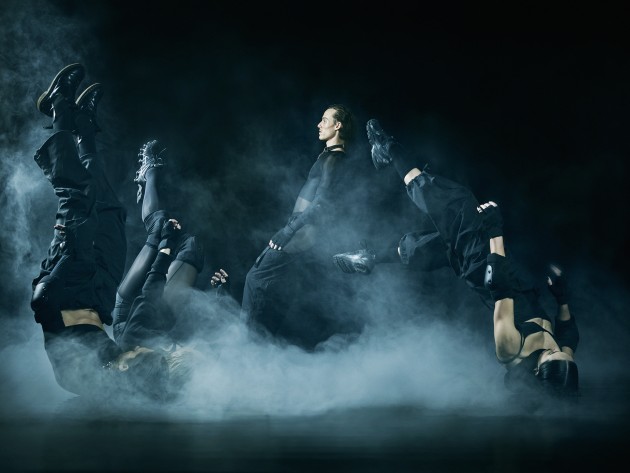
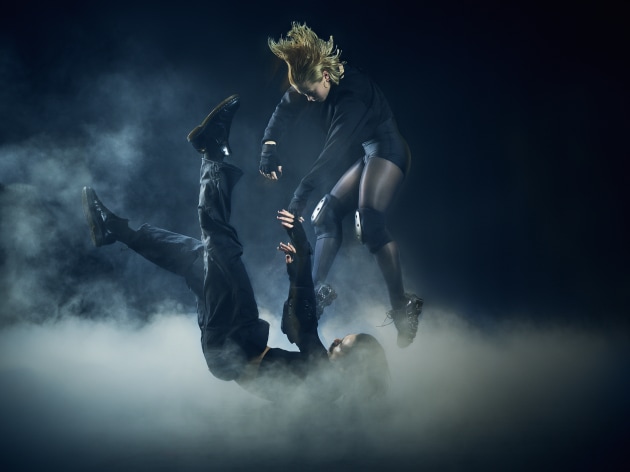
Jenni Large’s Alpha Mutt left the most striking “after-images”, Arlene Croce’s term for those residual imprints a work leaves long after you’ve left the theatre. Bodies suspended in space; long, sculptural shapes enhanced by Aleisa Jelbart’s costumes caught in semi-darkness; glimpses of flesh. Perhaps the relative slowness allowed those images to sink in.
Large writes of “the pleasure of giving over”, using repetitive, aestheticized imagery of dominance and submission to explore her “ongoing fascination with duality and power dynamics”. In the dark, smoky environment, and wearing what read as cutout fetish fashion, I saw deadpan BDSM — the couples, trios and groups reconfiguring who watches, controls and submits. I missed the expressive punch of Paula Rego’s Dog Women paintings, which Large draws on. The work was elevated for me by the dancers’ absolute commitment to the material, showing great integrity and artistic maturity.
There was a lovely sense of joy in Azzam Mohamed’s OUR(SELF). The dancers gave themselves over thoroughly to his choreography. They moved together, then individually, then individually together, creating a sense of community that worked particularly well in this intimate setting. In funky costumes they grooved and popped and essentially “danced out” for twelve minutes. I caught myself watching Rafael Bonachela in the front row, his face so utterly delighted by his dancers that his pleasure became part of the performance for me.
A confession: I hadn’t read the program notes pre-show. So I was surprised afterwards to discover that Raghav Handa’s ONE SONG was conceived as a kind of love letter to Sydney. I had placed myself solidly in India — the warm, earthy-toned costumes, flair and flamboyance, articulate gestures and feet beating rhythms into the ground bringing to mind scenes and characters from Indian films I’ve loved.
I enjoyed his play with familiar choreographic motifs and devices. I love a spinning dancer and a turning line. There were many striking moments. Sometimes I felt we circled back rather than evolved, but the piece certainly ended the evening with a bang.
There was a lot of electronic pulse throughout the evening and by the end I was beaten by beats. But the company looked terrific — diverse, strong, mature and individual. I was continually interested in who was dancing in front of me. Kudos to Rafael Bonachela for building a company of such distinctive and compelling dancers, and for curating an evening that allowed them to shine.
I would return to an event like Current readily. For me, it was, as its title suggests, current — more immediate, more intimate and, frankly, more bang for your buck.
-Emma Sandall