

Review: “Gloria – A Triple Bill”
Co3 Contemporary Dance and The New Zealand Dance Company
His Majesty’s Theatre, Tuesday 31 March 2026
Review by Nina Levy
True to the nature of its headline work, the opening night of “Gloria – A Triple Bill” felt celebratory. It’s a rare treat to experience a program featuring two contemporary dance companies. And when those two came together for Douglas Wright’s ecstatic interpretation of Vivaldi’s seminal work, exhilaration permeated the auditorium.
The seeds of that exhilaration were sown in Lament, a short work choreographed for this program by The New Zealand Dance Company’s artistic director/CEO Moss Te Ururangi Patterson and performed by his company of six dancers.
A reflection on “memory, resilience and the enduring spirit of Aotearoa”, Lament feels particularly imbued with resilience, most powerfully portrayed in a phrase bookending the work. Against Shane P. Carter’s thundering electronic score – infused with the mōteatea (lament) that inspires this work – the dancers cluster in formation as haze drifts around them. Drawing on elements reminiscent of haka, legs are planted wide and low, hands in tight fists. In unison arms and torsos swing as though gathering energy for resistance.
Grounded in ensemble work, Lament is also peppered with striking breakouts. Memorable examples include duets that evolve and dissolve, a trio of weaving heads, and several solos – Caterina Moreno’s arches and envelops, ‘Isope ‘Akau’ola’s lunges and bends, Anya Down’s flings and buffets.
Danced with gutsy verve by its cast, Lament made a compelling start to the program.
In contrast to Lament, A Moving Portrait – an excerpt from 2025’s In the Shadow of Time by Co3 Contemporary Dance artistic director Raewyn Hill – is meditative in quality. Beautifully performed by five Co3 dancers to Arvo Pärt’s Tabula Rasa, this work is, as the name suggests, a series of ever-changing tableaus that “[explore] what it means to be human”.
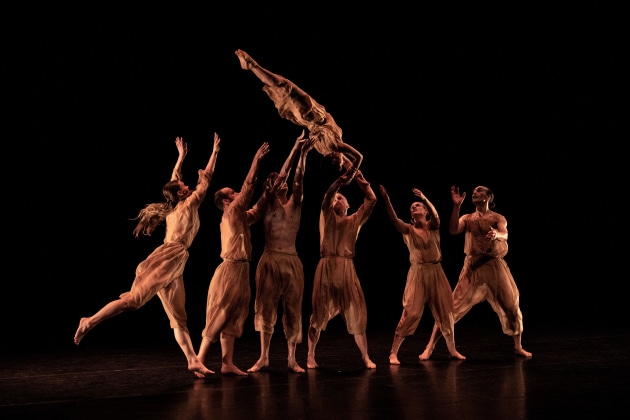
A Moving Portrait feels unearthly, however, from the first ethereal shaft of light (by designer Mark Haslam) that illuminates the dancers. Clothed in Akira Isogawa’s sculptural layers of tulle, they bring to mind renaissance interpretations of angels; their movements measured, serene.
Occasional moments of tension are the most engaging – a dancer (Francesca Fenton) floating in the air, suspended by hands that grasp her head; a wheel of dancers felled by a central figure (Fenton again); dancers held aloft like offerings to the gods. But these moments dissolve without further development. While the unvaried dynamic is clearly the point, I wanted more to evolve from these interactions.
That said, the restraint of A Moving Portrait intensified the exuberance of Gloria. Though made by the late Aotearoa choreographer Douglas Wright in 1990, to Vivaldi’s 18th century work of the same name, Gloria stands the test of time. Here it also stands the test of repetition, performed by Co3 just four years ago.
With the same music team performing live – St George’s Cathedral Consort and West Australian Symphony Orchestra under conductor Dr Joseph Nolan – the score’s liquid emotion was, again, beautifully rendered. In this season Co3 was joined by NZDC, and the chemistry and camaraderie between the dancers was palpable. Together they gave an expansive, captivating performance.
Watching the work a second time, I was struck anew by leaps that feel like peons of joy – bathed golden by Haslam – against Vivaldi’s exultant opening refrain.
As the work progressed I became aware of an undercurrent I hadn’t noticed previously. In the more sombre “Et in terra pax”, airy jumps are contrasted with struggling lunges. Watching Anya Down treading a staircase of heads, I was struck by the sense of joy and pain existing side by side.
Nonetheless, my overall impression remained one of buoyancy, in the dancers’ uplifted arms, frolicking pathways, loose-limbed drop-swings and star-shaped sautés. Set to Latin declarations about the glory of God, Wright’s slinking line of dancers in Haslam’s sultry half-light felt like a humorous yet spiritual pairing of the sacred and profane. The astonishing moment in which a dancer swings through the air like a human pendulum, performed here by Franky Drousioti, was just as breathtaking on second viewing.
Though I usually prefer a longer break between outings, Wright’s Gloria is an exception to the rule and, judging by the post-show buzz, this program filled hearts.
-Nina Levy