

In celebrating 100 years of Rambert, it is worth reflecting not only on the company’s extraordinary contribution to British dance, but also on its less frequently acknowledged role in shaping ballet in Australia.
While the history of Australian ballet rightly honours Edouard Borovansky’s foundational work, we might ask whether the contribution of Marie Rambert has been fully recognised. The character of Australian ballet arguably reflects the Rambert ethos as much as, if not more than, the formal Russian inheritance so often foregrounded in our narratives.
Before Rambert arrived on Australian shores, ballet had already taken root. Tours by Anna Pavlova in 1926 and 1929 ignited public enthusiasm. The visits of the Ballets Russes in the 1930s brought drama, technical brilliance and a sense of spectacle that captured the imagination of audiences. Borovansky, associated with these Russian tours, chose to remain in Australia from 1939. He and his wife, Xenia, established a school in Melbourne that grew into the Borovansky Australian Ballet Company, laying the groundwork for a permanent national company.
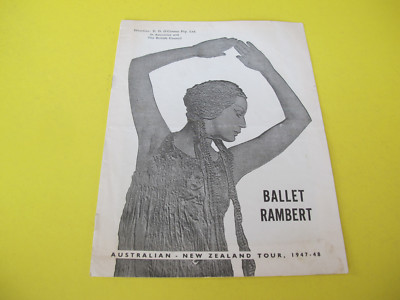
By the time Ballet Rambert embarked on its Australia–New Zealand tour of 1947 to 1949, the country possessed a fledgling ballet culture, largely shaped by Russian aesthetics and grand repertory traditions. What Rambert brought was something different.
When Rambert arrived in October 1947, it was the first major overseas ballet company to tour Australia after the Second World War. Audiences encountered an aesthetic that valued intimacy, musicality and artistic subtlety alongside classical rigour. Rather than relying solely on spectacle, Rambert’s repertoire offered a nuanced view of ballet as an evolving art form.
The response was remarkable. An intended six-month season extended to fifteen months due to public demand. Over the course of the tour, the company presented more than 500 performances of 33 ballets, including 26 English works previously unseen on Australian stages. Choreographers such as Antony Tudor, Frederick Ashton, Walter Gore, Andrée Howard and Ninette de Valois were introduced to local audiences, broadening expectations of what ballet could encompass.
The impact was not limited to audiences. There was significant exchange between artists. Australian dancers including Rachel Cameron, Charles Boyd and Ann Somers joined the company during the tour, gaining invaluable professional experience and exposure to British choreographic traditions. Some Rambert artists remained in Australia or returned later, contributing as teachers and mentors, thereby elevating standards and diversifying stylistic influences within the local scene.
The Rambert tour complemented rather than displaced Borovansky’s achievements. Where Borovansky had established structure, discipline and classical training, Rambert offered a broader artistic horizon. Together, these influences enriched the ecosystem that would eventually support the founding of The Australian Ballet in 1962. Its first artistic director, Peggy van Praagh, had been closely associated with Marie Rambert, carrying forward elements of that tradition into Australia’s new national company.
It is telling that the Australian ballet identity which emerged in the mid-twentieth century did not replicate a single European model. Instead, it blended Russian technique with British musicality and an openness to contemporary choreographic voices. In this synthesis, one can discern the Rambert imprint.
As Rambert marks its centenary, we might reconsider the narrative of Australian ballet history. The Russian tours planted essential seeds. Borovansky nurtured them into a sustainable enterprise. Yet the arrival of Ballet Rambert offered a vital expansion of artistic vision at a formative moment. It challenged audiences, inspired dancers and broadened the repertory landscape.
A century after its founding, Rambert’s legacy extends far beyond Britain. In Australia, it helped shape not only what we saw on stage, but how we understood ballet itself.
-Maggie Lorraine Storey