

The Australian Ballet's Copland Dance Episodes
Joan Sutherland Theatre, Sydney Opera House
Friday 6 November 2026
Olivia Weeks
Justin Peck’s Copland Dance Episodes catches The Australian Ballet in unusually persuasive form. Across its 73 minutes, dancers emerge as distinct personalities while contributing to a collective performance of considerable vitality. It is one of the strongest showings I have seen from the company in some time: expansive, physically assured and, despite occasional lapses, thoroughly engaging.
Created for New York City Ballet in 2023, the work might almost have been made for this cast. Peck’s choreography gives their athleticism a clear purpose, allowing individual strengths to register within the larger architecture. There is something Olympian about the endeavour, but the sense of renewal comes equally from the dancers’ responsiveness to one another. The company looks energised by the work.
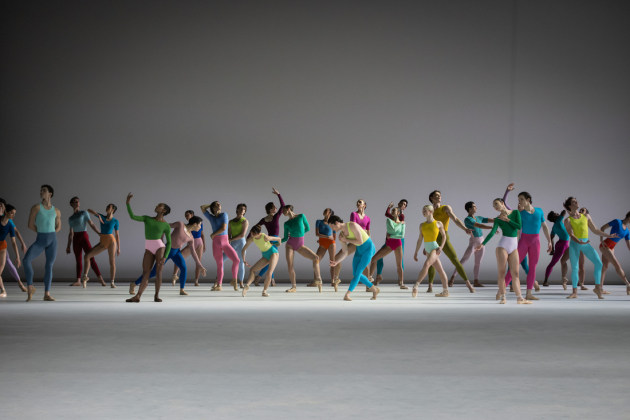
Thirty dancers move through 22 episodes set to Copland’s Fanfare for the Common Man, Four Dance Episodes from Rodeo, Appalachian Spring and Billy the Kid. The music, performed by the Opera Australia Orchestra, provides a familiar point of entry. Its gathering momentum and spacious releases give the evening a breathing rhythm, sustaining the movement through changes of scale and mood.
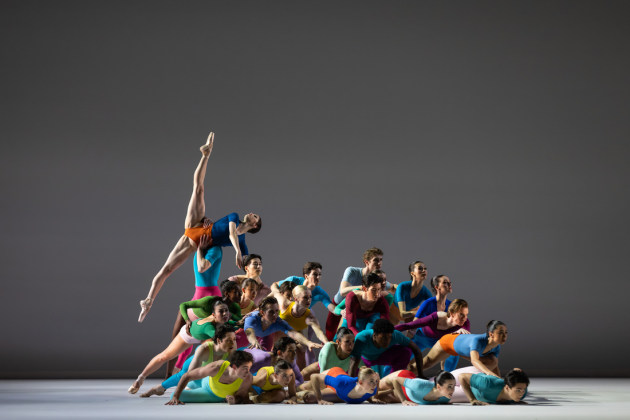
Peck obviously understands the dramatic possibilities of those changes. A large ensemble can establish a whole social world; a smaller grouping can bring one relationship into focus. Without a conventional narrative, the ballet still conveys the experience of belonging to a community, with its encounters, intimacies and shifting allegiances. Its tableaux are particularly effective: snapshots that seem to hold something of the movement immediately before and after them. They invite us to imagine lives continuing beyond the frame.
The Rodeo trio of Cameron Holmes, Henry Berlin and Drew Hedditch was a particular pleasure. Their shared energy gave the section an engaging unity, and the larger Rodeo ensemble carried that momentum convincingly. Here, Peck’s choreography brought the company’s cohesion into especially sharp focus. The interest lay in how the dancers worked together - almost playfully - as much as in the appeal of any individual performance.
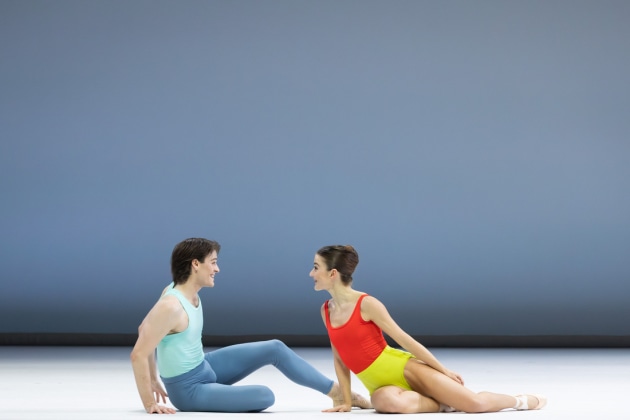
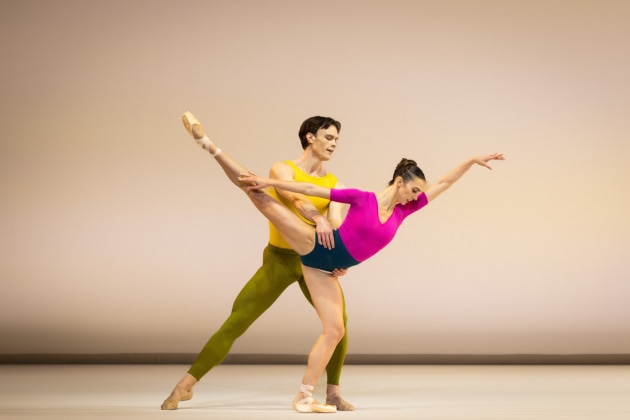
In Appalachian Spring, Benedicte Bemet and Elijah Trevitt proved exceptionally well matched. Their pas de deux had a playful balance, with both dancers contributing to its character. Bemet’s precision found an especially appealing freedom within Peck’s movement, and Trevitt was an attentive, equally engaging partner. This was my favourite performance of Bemet to date. The partnership allowed her artistry to feel immediate and unforced.
Riley Lapham, Yuumi Yamada and Grace Carroll also made a well-balanced trio, matching one another in energy while remaining individually recognisable. Lapham was especially compelling. Her contribution exemplified one of the work’s strengths as company repertoire: it creates opportunities for a dancer to command attention without disrupting the integrity of the group.
The visual design reinforces that interplay between the individual and the whole. Jeffrey Gibson’s hand-painted curtains are substantial works of art in their own right. Their colour and geometric organisation establish a strong visual presence around the dancing, giving the production a sense of scale beyond its relatively spare performing space. (If the Australian Ballet were to release these as a print or poster, I would happily hang it in my home)
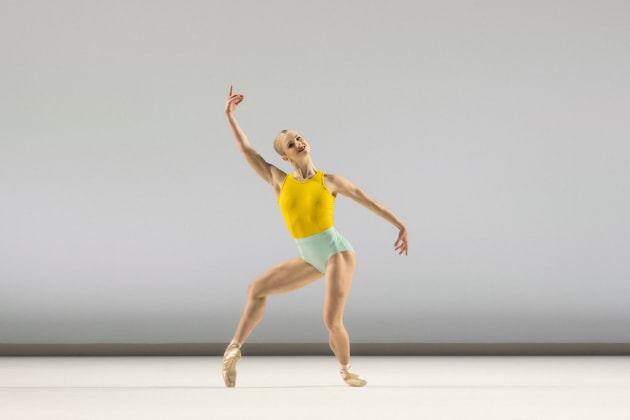
Ellen Warren’s costumes bring that colour directly onto the body. Their athletic silhouettes expose the dancers’ lines and the physical work of the choreography, while the different colour combinations help personalities remain visible within the ensemble. There is a satisfying correspondence between what the costumes reveal and what Peck asks us to notice: the particular qualities of each dancer and the larger composition they make together. Brandon Stirling Baker’s lighting completes the production’s visual clarity.
The evening was not flawless. There were missteps and passages in which the energy flagged, and the pace was more compelling in some episodes than others. In choreography so dependent on relationships between dancers, small inconsistencies register. Greater consistency would sharpen an already strong performance.
Yet the compact running time serves the work well. At 73 minutes without an interval, it offers enough breadth for its changing moods while keeping its central impulse intact. Even when the momentum dipped, the pleasure of watching remained.
In his welcoming remarks, David Hallberg spoke of joy. On this occasion, the word felt earned. It arose through the music, the playfulness of the choreography and the evident suitability of the work to these dancers. Copland Dance Episodes gives The Australian Ballet room to show both its collective strength and the artists within it. For that, and for the sheer enjoyment of the evening, it is unmissable.
Copland Dance Episodes continues at the Joan Sutherland Theatre, Sydney Opera House, until 21 November.