

Justin Peck’s Copland Dance Episodes
The Australian Ballet
The Regent Theatre, Melbourne
Tuesday 23 June 2026
Justin Peck is a New York-based choreographer who holds the position of resident choreographer with New York City Ballet, the company he formerly danced with. While the Australian Ballet’s Artistic Director David Hallberg formerly danced with a different New York-based ballet company, the American Ballet Theatre, his locality to Peck’s body of work would have undoubtedly been instrumental to influencing his interest in the choreographer – and his subsequent desire to bring the choreographer’s work down under. In 2023, Hallberg brought Peck’s Everywhere We Go to Australian audiences, a nine-part ballet which was presented as part of the triple bill ‘Instruments of Dance’. Now, in what may be the most anticipated premiere of the season (if the sheer audience numbers at the theatre are anything to go by), Hallberg brings Peck’s Copland Dance Episodes to Melbourne.
Created in 2023 for the New York City Ballet, Copland Dance Episodes is an eighty-minute neo-classical work scored by American composer Aaron Copland. Nicknamed the Dean of American Music, Copland was an influential composer of the mid-20th century, whose iconic Fanfare for the Common Man is widely recognisable and used in everything from Star Trek to 7 Sport programming. Initially, Peck used Copland’s Rodeo score to create Rodeo: Four Dance Episodes in 2015. This early exercise would go on to shape the creation of Copland Dance Episodes as a full-length work, featuring excerpts from Copland’s Fanfare for the Common Man, Rodeo, Appalachian Spring, and Billy the Kid.
Upon entering the theatre, we are met with the work’s first focal point: A painted stage curtain displaying a colourful geometric design. In the centre of the curtain is one large circle containing concentric circles, partnered by two smaller coaxal circles on each side, also concentric, and surrounded by a triangular grid pattern. On each side of the colourful curtain is the phrase ‘THE ONLY WAY OUT IS THROUGH’. This design has been created for the ballet by American Mississippi Choctaw/Cherokee painter and sculptor Jeffrey Gibson, who represented the United States at the 2024 Venice Biennale.
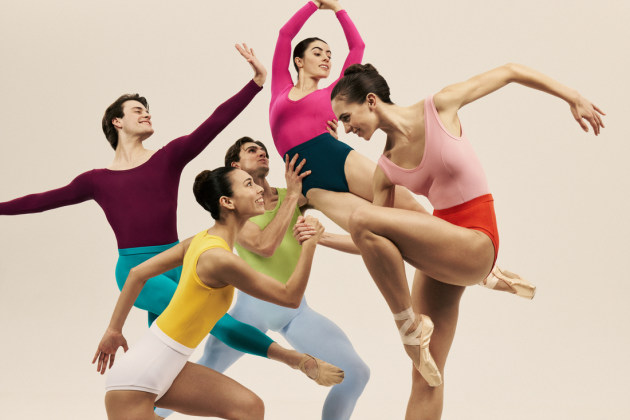
While the curtain remains down, the orchestra commences Copland’s atmospheric Fanfare for the Common Man. Before we even glimpse the dancers, we understand that Copland Dance Episodes is a work in which the orchestra plays a central role. The curtain lifts to reveal the dancers of The Australian Ballet scattered across the starkly lit white stage, all wearing colourful leotards and tights – splotches of lime green, barbie pink, and aquamarine are accented against the white background. Softening the contrast is a layer of white tulle covering each of the dancers’ bodies, encasing their faces, arms, and legs with a delicate and fluid form that extends corporeality through a mere shadow. In costume designer Ellen Warren’s creations, the dancers evoke mounds of coloured fairy floss, offering a perfect counterpoint to the score’s dramatic fanfare and highlighting its undercurrent of melodic dreaminess.
The dancing gets going and a squad of men emerge from the group, comprising Cameron Holmes, Maxim Zenin, Elijah Trevitt, Brodie James, Drew Hedditch, Adam Elmes, Henry Berlin, and Samuel Akins. The squad shifts and oscillates in form and in number, flowing seamlessly between group work and then breaking off into solos, duos, and trios. The men are working hard: visibly pushing themselves, sweating, taking deep breaths and exerting bursts of power. The fact that this hard work is not hidden is a distinguishing characteristic of Peck’s choreography. While the forms are as precise as ever, the dancers do not obscure the effort in their bodies – choreography is enacted with full transparency of its intense labour – an unusual affect in ballet that indicates Peck’s questioning of inherited classical tropes.
Senior Artist Isobelle Dashwood emerges with a solo and establishes herself as super at home in Peck’s virtuosic choreography with airy arabesques and crisp footwork. Dashwood is joined by Corps de Ballet artist Jeremy Hargreaves, and the two present an energetic, technical, and expressively pas de deux which carries on throughout the ballet eventually petering out with a change of directions and subsequent quarrel. While technically demanding this pas de deux is also intensely emotional, and the pair are mature in their treatment of the romantic mood which escalates into conflict and despair. Offering a counterpart to the turbulent pas de deux between Dashwood and Hargreaves is a pas de deux comprising Soloist Samara Merrick and Senior Artist Maxim Zenin, who bound effortlessly through demanding allegro, deliver flawless extensions, and never falter in the choreography’s challenging changes of direction.
This first section comes to a close with a trio of men lunged in the centre stage with index fingers pointed up towards the stage ceiling. A trio of women comprising Principal Artist Benedicte Bemet, Senior Artist Yuumi Yamada, and Coryphée Riley Lapham bound onto the stage, and with extraterrestrial-like wonderment ping the fingertips of their respective male partners, causing them to melt onto the ground. This sequence repeats several times, offering a fittingly imaginative reference to Copland’s influence in sci-fi film scores. Amongst this spirited female trio, several solos by Lapham pull focus with bombastic arabesques and pirouettes – she is long, lithe, and powerful, with extensions up to her ears and worldclass footwork. While occasionally a difficult pirouette sequence wasn’t executed perfectly, this didn’t detract but rather highlighted the beauty of Peck’s choreographic style, which prioritises a rhythmic flow of movement in space and time over virtuosic exactness. Rather than subjects enacting predetermined choreographic procedures, Peck’s fluid sequences, combinations, patterns and reversals reposition the dancers’ bodies as physicalisations of continuous gestures, glimmering reflections of sound realised in an expansive white landscape. As described in the performance synopsis, these episodes continue to flow organically throughout the work, with ‘characters emerg[ing] then melt[ing] back into the ensemble.’ These dreamlike appearances and disappearances of form and configuration lull the viewer into a hypnotic trance in which the ballet becomes kaleidoscopic. Rather than rigid, Peck’s proposition for ballet in the 21st century is multiplicitous – it is cheeky as it is serious, communal as it is individualistic, poetic and athletic, formulaic and spontaneous. It is many things, and Peck’s Copland Dance Episodes provides a rich choreographic tapestry in which those possibilities can come to life.
Following a memorable dance-off in the Round Table episode, a lazy susan-like dance in which participants take turn ordering their meals through movement, the work finds its closure in an energetic finale with the whole ensemble which fades suddenly into darkness. As another geometric-psychedelic Gibson-curtain lowers on the stage, one can almost hear the echoes of Copland’s sweeping score continue to play out – maybe in another galaxy far, far away.
Copland Dance Episodes runs at The Regent Theatre, Melbourne, from June 23 – July 2, and premieres at The Sydney Opera House in November. Tickets available here.
-Belle Beasley