

Stephanie Lake’s VISTA
Wednesday 5th August, 2026
Carriageworks, Sydney/Eora
Canada-born, Melbourne-based choreographer and artistic director Stephanie Lake presented her new creation VISTA at Sydney’s Carriageworks this past week. Following the work’s debut at Melbourne’s Malthouse Theatre, VISTA has toured to Sydney and continues its national tour to Brisbane next week. VISTA incorporated the artistic contributions of Lake’s usual creative team - Robin Fox as sound composer, Bosco Shaw as Lighting Designer, and Georgie Cleary of Alpha60 on costume design. The work featured six dance artists who are regulars in the independent contemporary dance landscape - Rachel Coulson, Robert Tinning, Marni Green, Tyrel Dulvarie, Georgia Van Gils, and Hugo Poulet.
Prior to VISTA, Lake’s most recent creation was Seven Days, made on the dancers of the Australian Ballet during Lake’s tenure as the company’s Resident Choreographer. VISTA’s central concept is a nod to the influence of this tenure on Lake’s creative process, in its emphasising of the interval, a feature of performance formats more common in classical ballet than in contemporary dance. This premise offers a seemingly simple but conceptually generative starting point. An interval, as the blank space of the performance experience, offers an empty temporal and conceptual space onto which much can be projected. In the creation of a dance work, the interval does not often occupy a central focus.
In VISTA, the concept of the interval formed the work’s structure as well as influencing its choreographic material. Split into two acts, the work played with the notion of perspective through strategies of repetition and opposition - across Act 1 and Act 2, similar movements, sequences, forms, and spatial structures played out with varying differences. This created a sense of having seen the same work twice but from different perspectives - like an opposing mirror image.
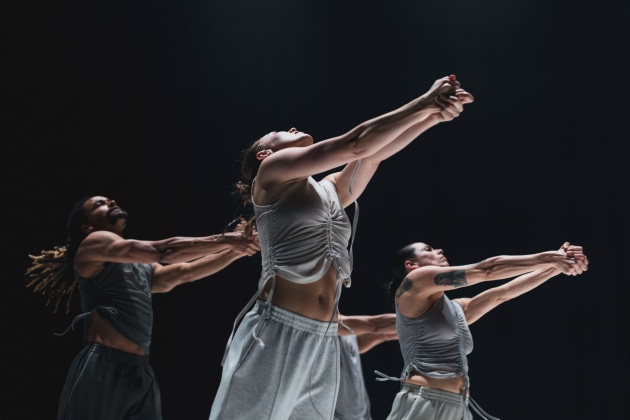
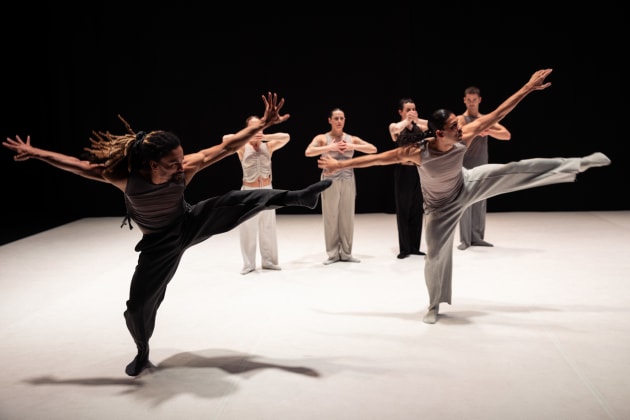
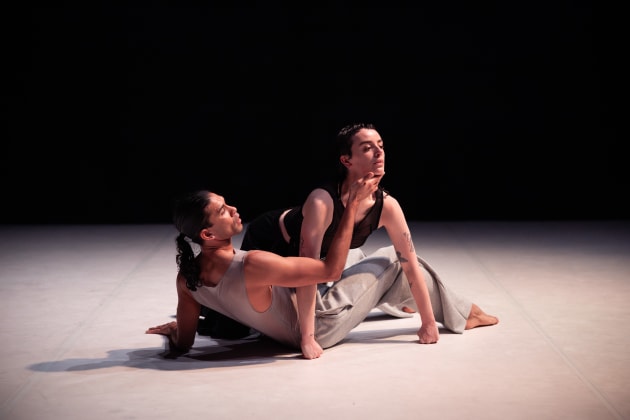
The work opened in darkness, and with a flash of sound and sudden light the dancers appeared on stage costumed in a spectrum of tones - white, grey and black. Movements were sleek and clean. Although, compared to Lake’s last balletic foray, VISTA is firmly contemporary, the influence of classical forms on the material could be detected. Amidst the fluid transitions which characterise Lake’s movement language, moments of fixed shapes and geometric lines were more pronounced than usual. Several duets spotlighted the high level of technical and expressive skills in the troupe. Act 1’s first duet between Georgia Van Gils and Robert Tinning was compassionate and melancholic, with freeze frames of suspended control interspersed with sequences of poetic abandon. Rachel Coulson’s solo moments rolling across the floor with aplomb stood out for their masterful control and ecstatic virtuosity. Act 1 finished with Van Gils and Marni Green rippling effortlessly between fidgety movements and structured shapes to a softly jingling soundscape, with minuscule movement differences highlighting in their otherwise perfect synchronicity.
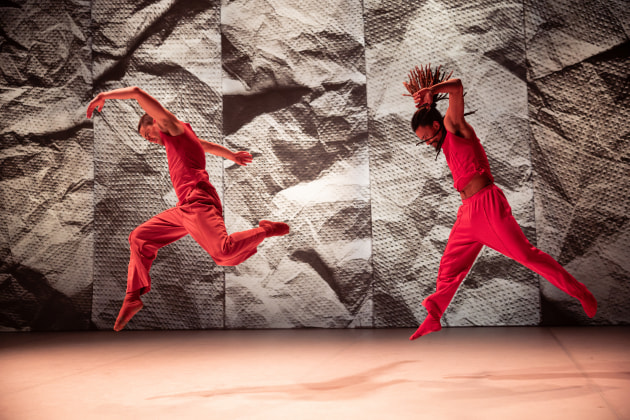
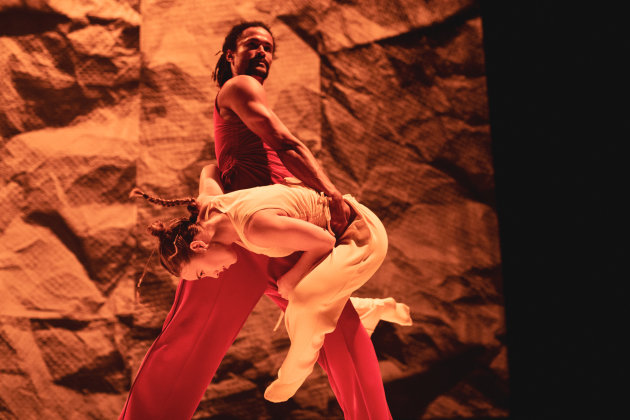
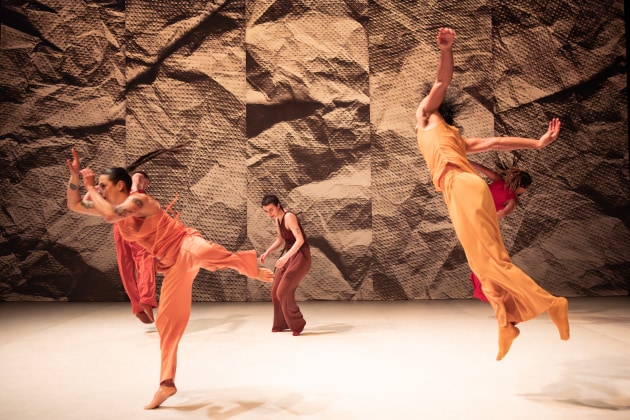
Following the interval, we re-enter the theatre space presented with a brightly lit set and a backdrop displaying four parallel strips of what appears to be images of scrunched up paper. The dancers emerge in the light costumed in the same silhouettes but now in a spectrum of burnt colours - red, orange, yellow. The soundscape is more elongated and reverbed, and movements are performed with drawn-out fluidity. Their indulgence in a slowed down execution conveys a peacefulness, bordering on placation - are the dancers harmonious, or, as a more dystopian reading might suggest, submissive? Sections are repeated from Act 1, or at least we sense a repetition - how exact this repetition is becomes difficult to tell, as Act 1’s material has already faded from memory. Nonetheless, moments and markers of the work feel the same, albeit danced with a different quality, by a different dancer, or in a different register. This repetition found its climax in the work’s pivotal feature - its use of voice. Repeating a group section from Act 1 with Marni Green at the centre, the dancers twisted, turned and flipped intermittently, all while narrating their movements, either expressing their inner dialogue or repeating phrases uttered during rehearsal. These vocal expressions, grunts, and articulations, revealed a layer of choreography usually unseen - the inner process of dancing, of executing movements and collaborating on choreographic structures, as well as the mental battle of choreography (see: Green’s grimacing whine “Stupid dancing!”). While this vocal section spoke to VISTA’s premise (the exploration of alternate and multiple perspectives through the impetus of the interval), some of Act 2’s ‘alternative versions’ had the result of creating the very binary that Lake had attempted to dispel - where Act 1 was monotonal, Act 2 was colourful; where Act 1 was sleek, crisp, clean, Act 2 was bubbly, expressive, joyful. Following a reference to the interwoven arm formations of Swan Lake’s iconic cygnets, Act 2 concluded with a hedonistic group rave section featuring heavy beats, aggressive stomping and ecstatic motions, another direct contrast with the first act’s minimal and controlled conclusion.
Lake’s VISTA is a work that delivers a punch across movement, sound, costume, and lighting. While some choreographic propositions could benefit from further development, the work really stood out for its use of an innovative conceptual premise. The interval as a concept in dance performance is often taken for granted, and rarely used productively. It is a space that either prolongs what is a painfully long performance, or it is a missed opportunity, a reprieve desperately longed for by audience members. It is a social moment, a toilet break, an opportunity for re-hydrating and re-snacking. It’s for furiously scanning the program notes to clear up synopsis and casting confusion, for taking a selfie in your theatre outfit and for eyeing other attendees in their get up. VISTA’s spotlighting of the interval created somewhat of a new relationship to this often ignored temporal structure. With heightened awareness that the interval would undoubtedly arrive, I could immerse myself in Act I with full presence. Knowing it was a central focus, I took the interval as equally exciting and in need of observation as the performance itself. As a result I returned to Act 2 with the sense that I had experienced something ambiguous and mysterious in the interval, and revelled in the unchoreographed magic of this theatrical void.
VISTA ran at Carriageworks between the 5-8 of August, 2026, and will continue at the Brisbane Powerhouse 19-22 August. Tickets available here.
- Belle Beasley