

The Chronicles.
Stephanie Lake Company with Young Adelaide Voices.
Adelaide Festival
Dunstan Playhouse.
12 March 2026.
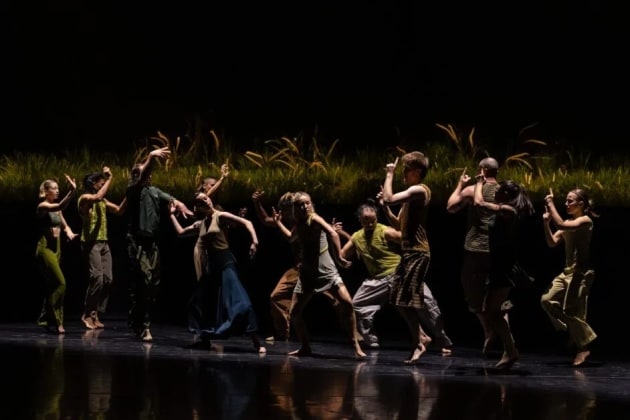
The curtain rises to reveal a figure in a foetal position under a giant lamp, like a chick in an incubator. Discovering her hand and feet, she moves them tentatively as a very young baby does. A sudden pulsing beat shifts the focus entirely, as the other eleven dancers in the ensemble burst onto the stage. What follows is a lengthy, dynamic segment in which ensemble passages are broken up by duets and trios. The twelve dancers are dressed in street clothes in hues of brown and green, and the movement vocabulary draws from ballet—an amusing take on the Dance of the Four Cygnets is a stand-out—Latin dance, most notably salsa, breakdance and other contemporary forms in a breath-takingly fast-paced fashion. The ensemble, comprising many of Australia’s most acclaimed contemporary movers, (Max Burgess, Rachel Coulson, Tra Mi Dinh, Tyrel Dulvarie, Marni Green, Siobhan Lynch, Darci O’Rourke, Harrison Ritchie-Jones, Robert Tinning, Georgia van Gils, Kimball Wong and Jack Ziesing) brilliantly execute Stephanie Lake’s eclectic and highly demanding choreography, seamlessly melding styles.
At this point, the percussive score by Lake’s long-term collaborator, Robin Fox, is loud, almost overly so, but suddenly we are cast into a quieter world as a ghostly choir of children appears at the back of the stage behind a scrim. Standing in a field of long grasses, dressed in white shifts and holding white lanterns, the unaccompanied Young Adelaide Voices, led by choir-mistress extraordinaire Christie Anderson, produce an exquisitely pure sound. At first this is wordless, but then soloist Ethan Lourie sings the traditional tune, ‘Ah Poor Bird’, shifting the mood to one of poignancy and sorrow. Downstage, the dancers move slowly in single file and create moment of stillness as they pause in unexpected groupings. When the choir joins them on stage, all talk and mill about, creating a sense of intergenerational community and warmth.
The next section introduces a martial mood, with the dancers clad in swirling full length skirts moving in columns downstage and enunciating a rousing Ra! Haa! Bosco Shaw’s lighting has them dancing between lozenges of light, then illuminates them mid-motion with strobes, creating an almost machine-gun effect. The movement is sharp and forceful, conveying a sense of power unleashed.
The narrative arc of the cycle of life is brought home with the final, autumnal passage. A bale of what looks like hay is dragged onto the stage by a male dancer; he is then joined by the other all dragging their sheafs. A gigantic playfight ensues. Golden downlights pick out the strands of grass as the dancer throw them repeatedly into the air; as they fall, they cover the stage as if in a gigantic threshing session. Tenor Oliver Mann appears behind the upstage scrim, vocalising wordlessly at first before delivering an exquisitely sad, slowed-down version of the pop song, ‘Forever Young.’ The dancers’ movements become slower, and they eventually bury one of their number in the hay. The final tableau returns us to the beginning, with the giant lamp descending from the flies to once again warm a figure curled up in a foetal position.
Performed by a superb cast, The Chronicles is marked by Lake’s customary mastery of ensemble movement but more importantly by a melding of theatrical elements to create a cohesive experience. Robin Fox’s score, especially his terrific use of choir and tenor, Bosco Shaw’s lighting, Harriet Oxley’s costumes and Charles Davis’s set combine to take the audience on a monumental, if episodic, journey through life.
- Maggie Tonkin