

Queensland Ballet
Messa da Requiem
Glasshouse Theatre, QPAC
March 27
Giuseppe Verdi’s Messa da Requiem, one of the most famous settings of the Catholic funeral mass, was composed in memory of the Italian poet and novelist Alessandro Manzoni and premiered to an ecstatic response in 1874. It is a monumental and demanding work, needing four opera-calibre soloists, a double choir, and orchestra. A run time of 90 uninterrupted minutes, together with the sheer number of performers, makes every performance an occasion.
More so when you add 36 dancers to the mix, which Artistic Director of Staatsballett Berlin, Christian Spuck has done for his epic interpretation of the work. First brought to Australia for the 2023 Adelaide Festival, this ambitious collaboration across artforms makes an intentionally grand start to Queensland Ballet’s 2026 season, the first curated by the company’s Artistic Director Ivan Gil-Ortega.
Verdi’s profoundly operatic and theatrical interpretation of the Catholic liturgical texts comprises seven emotionally charged sections. Spuck’s intention is to make these emotions even more visible on stage through movement, and while one could argue that there might be little to add to what is already considered a musical masterpiece, on the whole he succeeds, and without compromising either the work’s length or tempi.
The Brisbane Chorale combine with Canticum Chamber Choir to form the 100-plus choir, directed by Emily Cox AM, with Opera Queensland soloists Naomi Johns, Kyle Stegall, Cassandra Siedemann, and Jeremy Kleeman also on stage with the dancers. The Queensland Symphony Orchestra (QSO), under Simon Hewett, anchors the work from the pit.
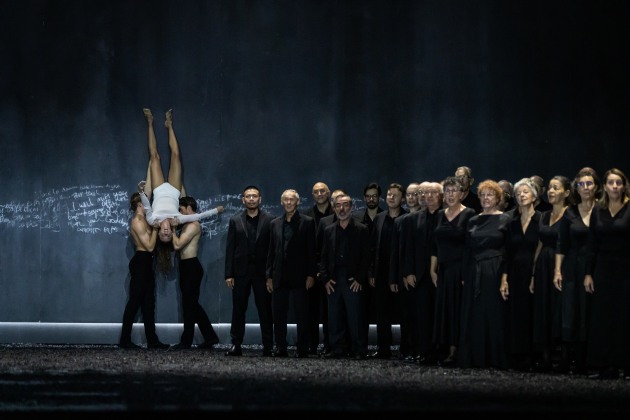
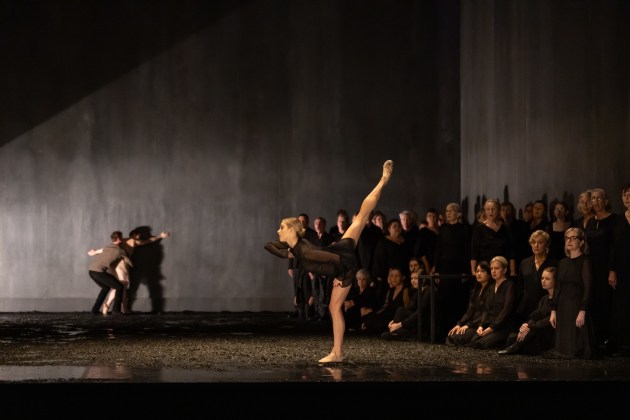
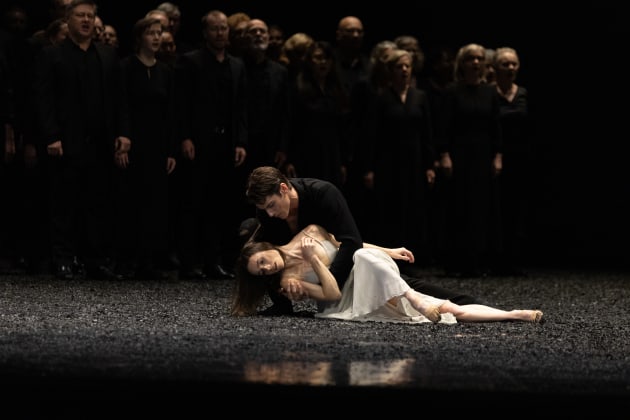
Designer Christian Schmidt’s gloomy setting of high stony-grey walls, with a black ash-like material scattered across the stage floor, contains the action. In keeping with the theme of death, costuming is universally black – the usual choral attire for the singers, relieved by the odd injection of paler off-white colours for solo dancers, signifying purity or innocence (design Emma Ryott).
In an understated beginning, the orchestra playing pianissimo, a single dancer edges tentatively along the back wall, while the choir, spread down opposite sides of the stage, sings whisper-quietly. From there it is a 90-minute roller-coaster ride, travelling the gamut of emotions from judgement and despair to faith, and hope for redemption.
Movement mostly helps unleash the Requiem’s full theatrical potential. Dancers aside, integrating the choir into the staging, rather than as a static narrator, makes it more of an operatic chorus, sometimes moving with the dancers, but always bringing a visually expressive meaning to the Latin text.
Choreographically the work is most compelling in the large group moments. Canon is often effectively used to rapidly move dancers and choir (often together) in striking patterns of movement around the stage to form different sculptural shapes, from a swarming mass of bodies reaching up a wall or a wave-like undulation down the diagonal. Movement in unison also creates striking visual episodes, the flesh tones of hands and faces a captivating focal point in the otherwise dark setting. Despite this unaccustomed flurry of movement while singing, the choir was always brilliantly cohesive, measured, and acoustically true.
The QB dancers effortlessly delivered Spuck’s eclectic mix of the classical and contemporary movement, both on and off pointe. The choreography is lithe, articulate, with an underlying tension of push and pull, and high, thrusting extensions. Several yearning pas de deux feature presage lifts holding limp bodies aloft – a repeated motif, perhaps a signifier of crucifixion and death.
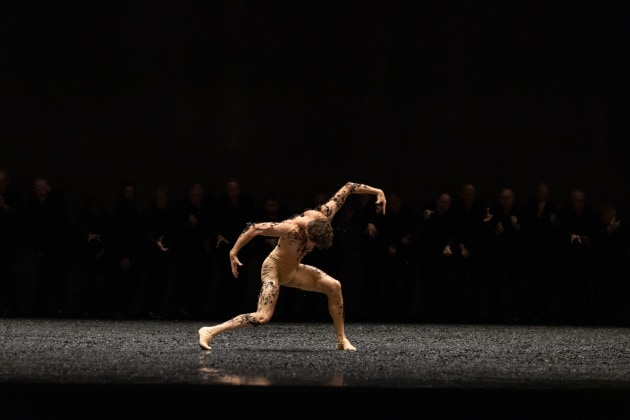
Featured dancers this performance were Lucy Green, Vito Bernasconi, Joshua Ostermann, Libby-Rose Niederer, and Ines Hargreaves in both solos and pas de deux. Ostermann, naked save for flesh-coloured briefs and spattered with black ash, grabbed attention early in the powerful second section, Dies Irae (Judgment Day), with a tortured solo of earthy, almost animalistic movement. In stark contrast the tender Lacrimosa, about grieving, included a soaring duet with Niederer.
There were moments however, when movement was superfluous. The Offertorio, a poignant section for the operatic soloists singing acapella, was so compelling that any movement by dancers became a distraction.
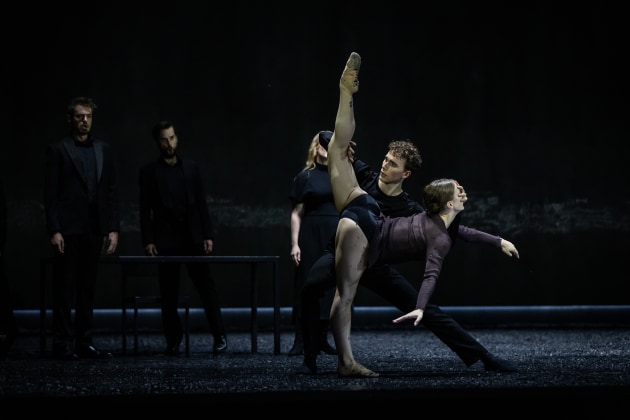
Another visual highlight had the female dancers in long black, voluminous tulle skirts, backs exposed to the audience, which while striking in itself, added little clarity of meaning. I also wondered about a couple of rather modern-looking steel tables appearing on set – their purpose unclear from my viewpoint.
As the work progresses, focus rests more on the lead couple Green (in a sheer cream dress) and Bernasconi (in black and brown). They are mesmerising in a duet which concludes the final section, Libera me (Free me). Started by soprano Naomi Johns, the theme then taken up by the chorus, this pas de deux of intricate arm movements of coupling and uncoupling expands into effortless lifts, creating a stunning meditative sequence that was quite breathtaking.
Spuck describes his interpretation of Verdi’s Requiem as a production, and not a ballet, perhaps acknowledging that dance is additional to an already superb work. It is nevertheless a massive undertaking, seamlessly executed here, and although the partnership between movement and music was occasionally uneven, it made a gripping start to the company’s 2026 season.
– Denise Richardson