

Review: EPIC
LINK Dance Company – Bachelor of Creative & Performing Arts (Hons)
Dance Theatre, Western Australian Academy of Performing Arts (WAAPA), 17 September 2026
Review by Nina Levy
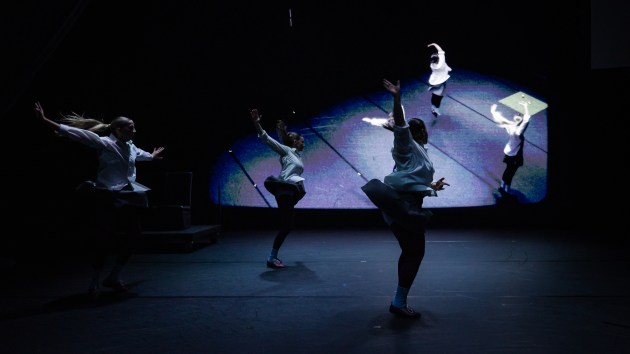
EPIC is LINK Dance Company’s second public season for 2026, but their first in WAAPA’s new city campus. Aptly described as “a jewellery box of a theatre” by LINK Artistic Director Michael Whaites, the purpose-built Dance Theatre’s pièce de résistance is an LED screen in place of a cyclorama, used to dramatic effect in this season (more about that presently).
The Dance Theatre is also intimate, with surprisingly little distance between stage and audience given that it’s a dance venue. LINK is part of WAAPA’s Honours program and with just five dancers in this year’s cohort – Alisha Subritzky, Olivia Taliangis, Madeline Rohde, Rebecca Andrawes and Megan Lamb – that proximity felt appropriate for this season. I’m curious to see how choreographers will respond to the space with the larger casts that characterise the dance department’s undergraduate seasons.
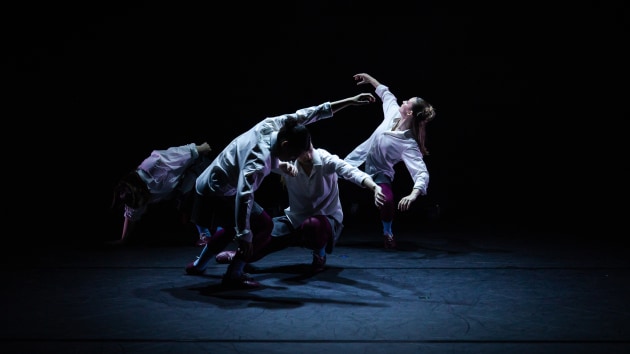
In this case, that intimacy also suits the work’s style. Choreographed by local independent maker Emma Fishwick and Whaites, EPIC is grounded in dance theatre tradition. Peppered with existential questions, the work is described as “a fever dream, a fractured road trip, a series of encounters that are never fully complete yet stretching across time and space.”
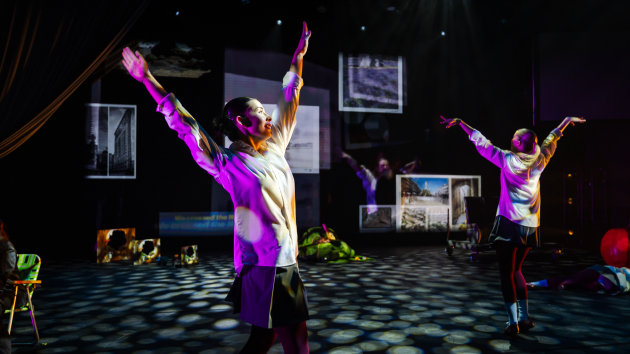
At times EPIC felt disorientating to me, but perhaps that’s the point. Certainly there’s a surreal quality to the various scenes, which melt into one another, like episodes in the aforementioned dream. Peter McAvan’s synthesised and sampled score creates an ever-evolving soundscape while projections (by production and design students Maika Gauden and Pepa Miller under the mentorship of AV Designer Jon Driscoll) transport us from the mundane to the psychedelic in moments. These many mood-shifts were adeptly handled by the cast on opening night.
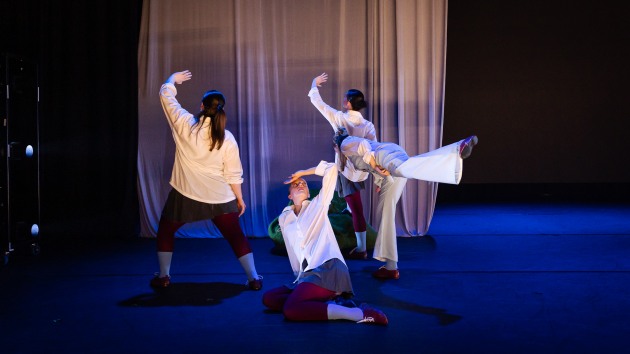
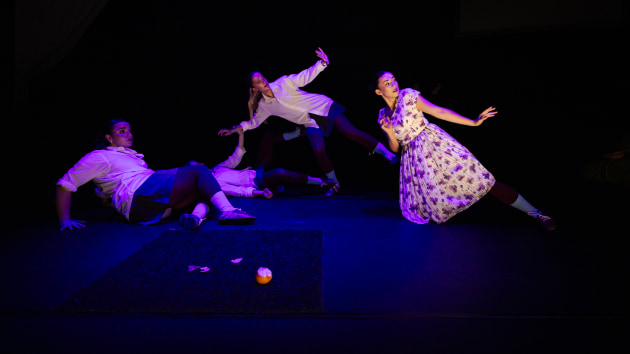
The dancers’ costumes are school girl-like, their grey skirts, pale blue socks pulled high over crimson tights and burgundy lace-up pumps perhaps a nod by Fishwick (also costume designer) to de Keersmaeker’s Rosas danst Rosas. Occasionally there are adaptations or changes, a lilac floral dress here, a sequinned leotard there, adding to the sense of an ever-changing dreamscape.
Utilising four undergraduate dance students, mentored by Driscoll as camera operators, scenes are filmed and projected live on stage. While this isn’t an original technique, it’s a fun touch and also helps to offset the relatively small cast and fill the performance space.
Now the dancers are creeping, pausing mid-stride, their hands extended as McAvan’s score tinkles and bubbles. Now two are in a car, a country road unfurling amidst the grey-green of West Australian bushland, before the scene dissolves. Against an ominous blast of sound the dancers form a series of tableaus, shielding themselves from an unseen impending disaster, arms raised, fingers outstretched.
There’s a distinctly Australian flavour to the work and one of my favourite sections cleverly films a series of model-sized sets (by Fishwick, with Gauden and Miller) that mash-up Frederick McCubbin’s 1889 work Down on his luck with Monty Pythonesque depictions of birds and cows. The result is a surreally comical 3D landscape on the LED screen, that pays homage to rural Australia’s fondness for “big” sculptures.
A disco scene also takes full advantage of the LED screen, filling it with technicolour as the dancers groove to 70s era pop, lighting designer Adelaide Harney’s spots and swirls adding a kaleidoscopic touch. Though all dancers performed this segment with zest, Subritzky gave a particularly charismatic rendition of the game-show hostess style poses scattered throughout.
While many professional companies perform with just five dancers, it’s a small ensemble for a full-length student production. Though the cast were supported by innovative visuals, at times the work felt sparsely populated. It seems likely that rising cost of living and increases in fees for tertiary arts courses in recent years makes a fourth year of study unfeasible for many. LINK offers an excellent program under Whaites and the facilities of the new WAAPA building are impressive – it is to be hoped that the numbers return to form in the coming years.