

Review: Triptych
Lewis Major Productions
The Studio, Sydney Opera House, Wednesday 16 September 2026
Review by Olivia Dimitra Christoforidis
This past week, Triptych was performed at the Sydney Opera House’s intimate Studio stage. Conceived by Bungandidj and Ngarrindjeri choreographer and director Lewis Major, the performance unites three short works – Prologue, Unfolding, and Epilogue – into an hour-long production. Since its 2024 debut and international tour, Triptych has returned to Australia, Major’s home. Supported by Fausto Brusamolino’s impressive lighting and James Peter Brown’s score, a small ensemble of just four dancers, including Alexander Abbot, Elsi Auricht-Faulks, Felicity Chadwick, and Tahlia Russell, commands the stage with quiet strength and precision. What they pull off is an unforgettable moment for Australian contemporary dance.
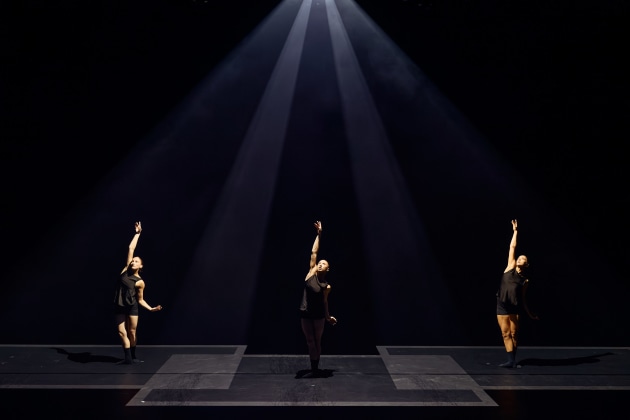
The performance opens with Prologue, an immediate exercise in tension. Underscored by a dull synthetic pulse, dancers Elsi Auricht-Faulks, Felicity Chadwick and Tahlia Russell occupy individual squares of white light. Dressed in simple black dancewear, the trio moves in controlled alignment: one dancer stands and spins quietly in place, matched by the low-slung, sweeping rotations of the performers kneeling to her left and right. This unity is sustained throughout Prologue, escalating alongside a score that grows restless, agitated, and loud. By casting stark white illumination against shadow, the stage takes on an unexpected depth. This effect is most striking when the projection inverts: the shadows turn white, and the white squares turn black, swallowing the dancers. It is here the spectator becomes an active participant, both witness to and complicit in the spatial illusion engineered by Lewis Major and Fausto Brusamolino.
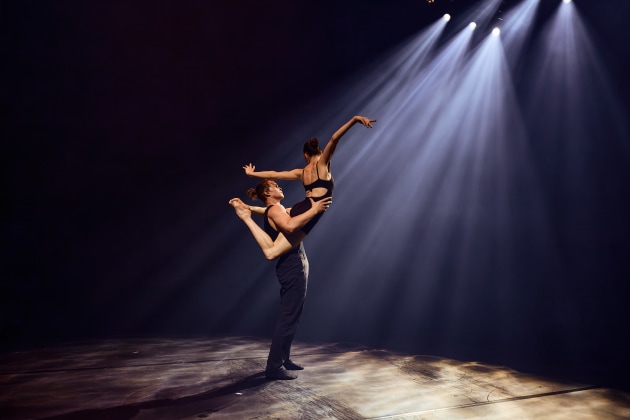
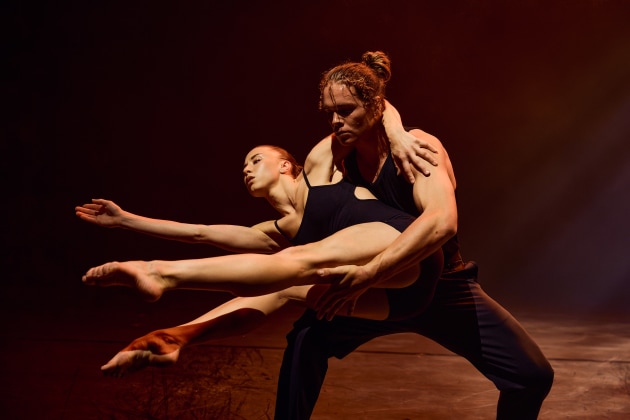
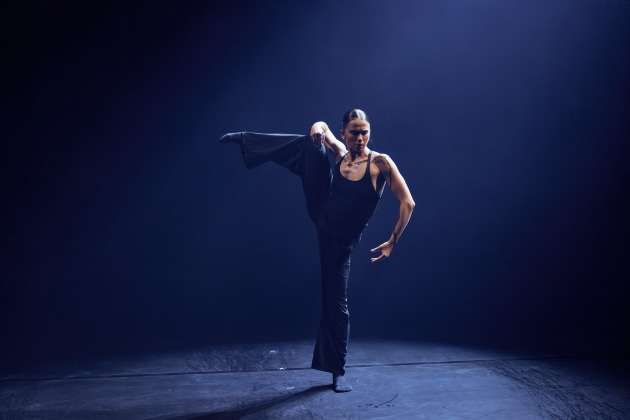
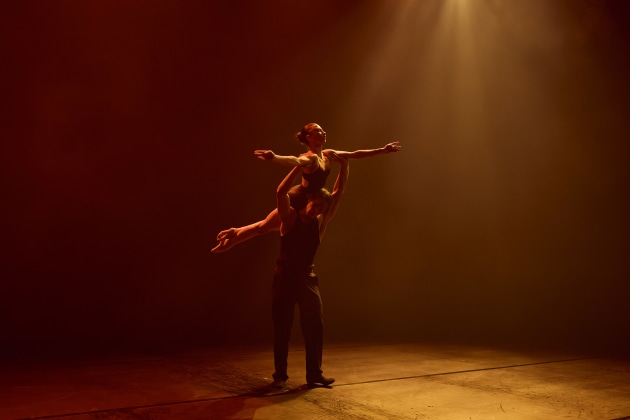
After a short intermission in which the audience is permitted to converse, Epilogue: Act I – Lament commences. A deep vocal hum reverberates throughout the venue, a surprising change in musicality that makes clear this production is neither predictable nor traditional. Poised under this heavy quiet, soloist Felicity Chadwick stands entirely isolated on stage with a paintbrush in hand. She begins tracing her bare forearms with black paint, then, in a stunning feat of athleticism, draws the brush up her leg as it extends into a side split. Her body is effectively a canvas, and the choreography itself reads like performance art. With a delicate sigh, she brushes her face and intimately retraces the wet lines on her arms and collarbones. Following Chadwick’s solo, Alexander Abbot and Elsi Auricht-Faulks execute a beautifully tense pas de deux. While the score coalesces into a choral, guttural explosion, their movement remains controlled – a recognisable feature of Major’s choreography. Verging on balance, the duo moves with a tension that makes the audience fear Auricht-Faulks might tumble. Abbot’s arms shake as he presents her skyward; her legs are slightly bent, and arms outstretched, before she curls around his body and collapses downward. As the light fades, she hugs him from behind, legs extended, before they spin, sustaining this momentum into stage blackout. This striking image concludes Epilogue: Act I – Lament.
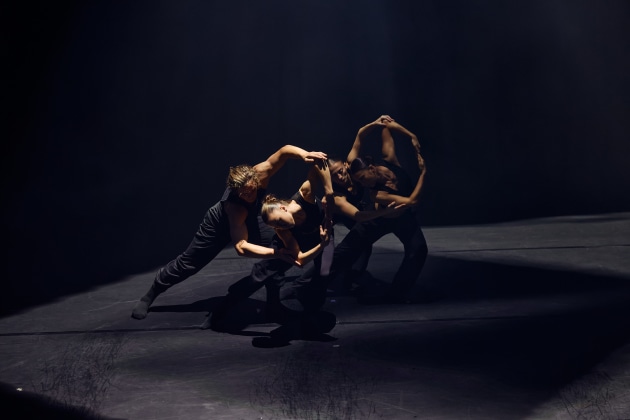
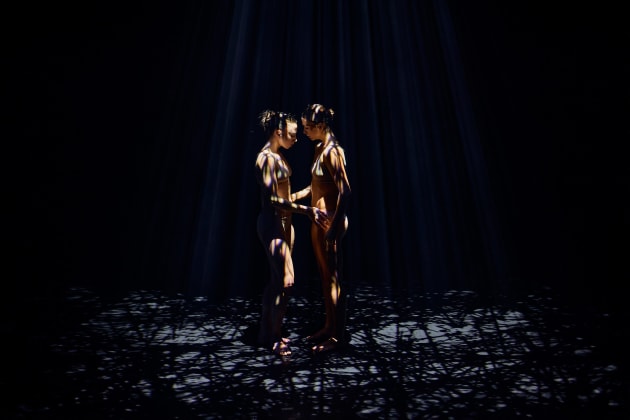
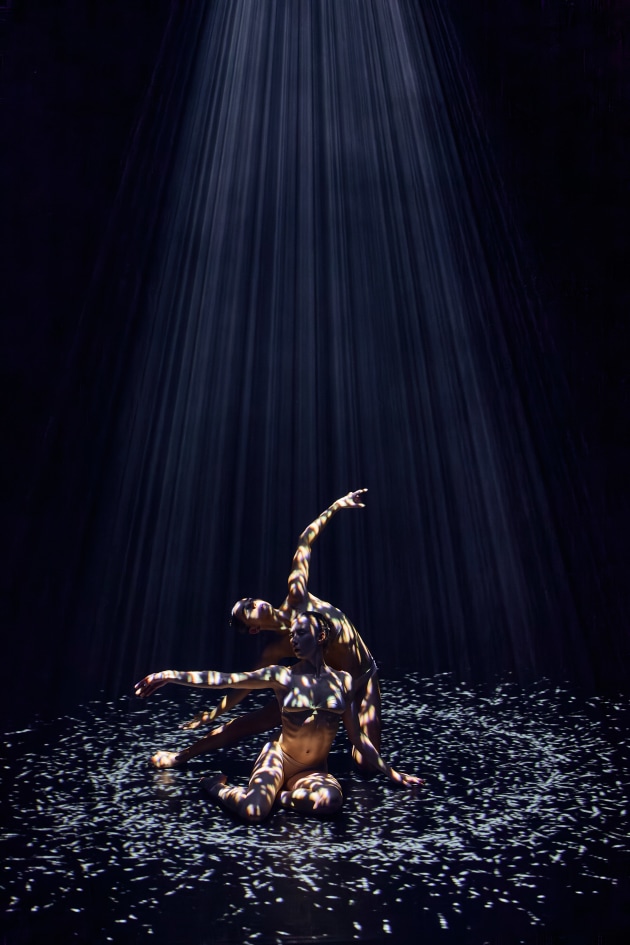
Unfolding is the first segment to feature all four ensemble members. Returning to the futurism established in Prologue, Brusamolino’s projection scans the dancers in white, vertical lines. The light’s texture shifts – ocean waves, honeycomb, foliage patterns – against a clinical electronic pulse. Moving like organisms, the performers share a distinct, unguarded responsiveness to one another. In scattered unison, they search for each other, lunge, and extend, Abbot an anchor in a maelstrom of light and sound. At the height of this disorganisation, Brusamolino restores order by dissolving his projections into a singular beam. Here, a compelling illusion is achieved: a soloist spins herself in congruence with the light, as if she is simultaneously balancing, trapped, and supported by it. A second dancer enters. They traverse the beam from opposite ends, shedding their black garments for nude dancewear, before folding over one another, heavy and bound by gravity. Small white lights flicker over their skin. As their arms reach out and their bodies collapse, the flares expand, leaving them stranded in a crimson ring. The remaining two dancers slip onto the stage from the dark, barely perceptible. The light cuts, leaving only the accomplished ambition of Major’s directorship.
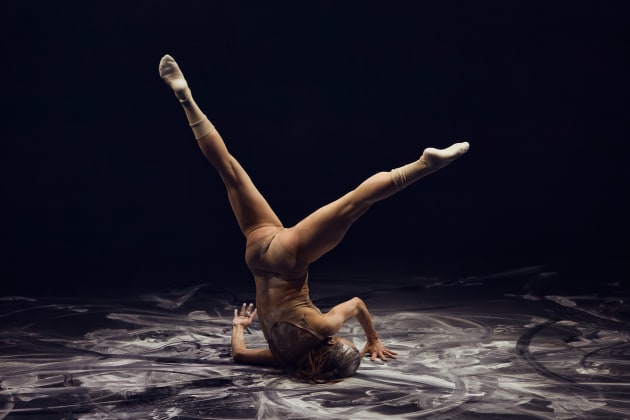
Epilogue: Act II revisits the kind of body art witnessed in the first Epilogue to a piano arrangement by Dane Yates, after Debussy. Performing the solo under simple, unadorned light, Elsi Auricht-Faulks begins with subtle gestures: a steady, deep inhalation, a shift of the head. With flour, she carves circles beneath herself, remaining in physical conversation with the stage floor. As her body loosens, she displays immense technical prowess, kicking up billowing circles of white as she lunges, spins, and bows. The music arrangement warps and reintroduces an electronic soundscape, while soloist Auricht-Faulks stands tall and spins centre-stage, even as the lights cut to blackout.
Lewis Major’s Triptych is a tremendous feat of modern dance. He rejects traditional dance conventions, choosing instead a more deliberate vocabulary borrowed from sculpture, light, and architectural form. In collaboration with Fausto Brusamolino’s lighting and James Peter Brown’s score, Major has not so much choreographed a dance as he has articulated a very particular, anxious kind of human geometry. Bold and unconventional, yet rich with the detail and athleticism expected of elite contemporary choreography, the work confronts the audience with an expanded vision of what dance can be.
-Olivia Dimitra Christoforidis