

Theatre of Dreams.
Hofesh Schechter Company.
Festival Theatre, Adelaide Festival.
13 March, 2026.
Adelaide audiences were introduced to Hofesh Schechter via his work, Grand Finale in the 2019 Festival. Schechter tackles big themes: Grand Finale, for example, explored the extremes of human behaviour during end times. Theatre of Dreams is billed in the program as taking a plunge into the subconscious ‘exposing the fears and desires that elate us.’ But whereas Grand Finale was tightly structured and built to a climax, Theatre of Dreams is overly long and in need of a dramaturg.
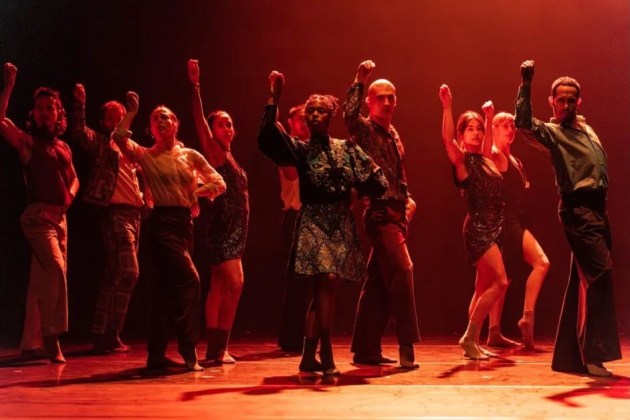
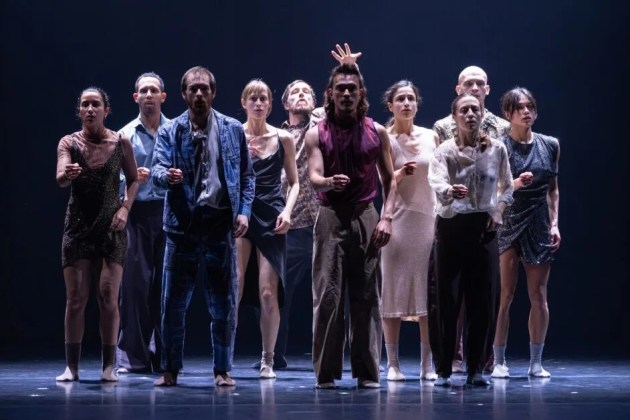
It starts brilliantly: the opening gambit of a man appearing before the house curtain, looking nervously back at us before ducking through a gap, conveys the idea that he is entering into the private or even forbidden world suggested by the title. Thereafter there is much play with curtains, with individuals or groups of dancers revealed in static tableaux, or glimpsed in frenetic motion as the draw curtains part and close in rapid sequence. Lighting designer Tom Visser brilliant use of down spots in the darkened stage creates a sense of enclosure, greatly abetting the sense that something is being revealed with each tableaux.
The twelve dancers are superlative exponents of Schechter’s style: his trademark mélange of house, ballet, contemporary, folk moves, gesture and social dance is as a sharp and demanding as ever in this work. Movement is predominately of the torso and arms, shifting rapidly from languorous to jagged, humanoid to simian, with the legs used primarily as a means of locomotion. And there is an awful lot of locomoting for them to do: scene follows scene as they dash about the stage to be revealed by the shifting curtains singly or in pairs, or in groups of six that weave through each other, at times removing their clothes and at other, putting them back on. Desire, violence, grief and longing are all invoked, but while this frenzied activity is initially riveting, after a while it becomes repetitive and almost cartoonish, and one starts to wonder what the point of it is.
Schechter always composes his own music and here, as with Grand Finale, there is a live band. In the early stages of the work is seems as if we are listening to a taped soundscape of white noise overlaid on a heartbeat, which gradually becomes unbearably loud, but there are welcome interludes when the nattily red-suited trio appear on changing sides of the stage. These tremendous multi-instrumentalists cover vocals, brass, keyboard, guitar and percussion, and their appearance interrupts the frenetic rushing about of the dancers. At one point, the dancers sit on the floor, backs to the audience and simply listen to the band; at another, the band plays a Spanish song to which the dancers strut their stuff in gorgeous Latin style. Some audience participation follows, when the dancers urge the audience to ‘let themselves go’ by getting up to dance, to which most of those in the auditorium respond enthusiastically.
There are some effective slower moments, more so in the later parts of the work. A group of dancers is revealed in a reddish transparent cube lifting their arms in prayer or supplication; the whole cast stands intently before an elaborate curtain far upstage, creating a sense of anticipation—will this be the final reveal? Unfortunately, no: the work continues after this natural ending, and at ninety minutes runs far too long. Ultimately, after having seen Schechter’s earlier, brilliant Grand Finale, this work is a disappointment: it’s not just overlong but seems devoid of structure—an endless succession of tableaux snapshots that reveal very little apart from frantic motion.
- Maggie Tonkin