

Review: Gideon Obarzanek, Glow
Presented in the Australian Dance Biennale hosted by Rising Festival
Chunky Move Studios
Reviewed Thursday 28 May
Glow
It’s rare for the centrepiece of a contemporary dance festival program to be a work from the archive. Usually arts funding is funnelled into the new - bolstering new works to be made, offering new opportunities, researching new ways of working and engaging the latest in technology and design. For the inaugural Australian Dance Biennale, director Gideon Obarzanek (previously director of Chunky Move) has taken a different approach, but a strong one. Glow presents a restaging of a work Obarzanek made for Chunky in 2006, a work which was highly acclaimed and went on to tour internationally for several years before retiring to the annals of Australian dance history.
When it first premiered, Glow made an impact due to its innovative use of technology. The work is a collaboration between Obarzanek and acclaimed ‘engineer in the arts’ and interactive video designer Frieder Weiss, whose capabilities with interactive technologies were ground-breaking for the time. Weiss has gone on to work with several large productions, including producing the visuals for Kylie Minoque’s Get Outta My Way video clip.
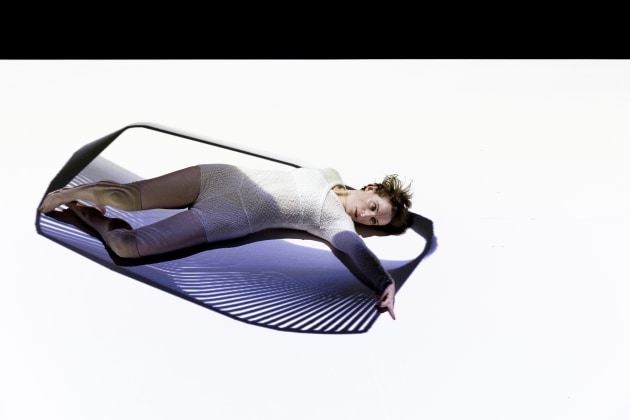
Rather than focusing on a narrative or theme, Glow is a choreographic essay that explores how technology extends the limits of the body. Taking place on a small square stage in the Chunky Move studios, Glow features only one dancer: original cast member Sara Black in this particular performance, but Chunky Move dancer Melissa Pham and Sydney-based dance artist Layla Meadows were also on the cast sheet. Throughout the work, however, the abstract patterns of light created by Weiss’ interactive video technology almost take on a character, until it feels like we are watching two bodies on stage.
Black began the work curled up like an embryo. The video technology tracks and responds to her movements, creating a seamless experience where the visuals echo choreography and create the effect of an extended body. We don’t just witness the performer in motion: through Weiss’ technology, the energy of the body, its dynamics, its power, and its qualities are made visual. Unlike visuals in most performance works, these are not pre-fixed. Whilst Weiss pre-programs the algorithm which informs the video, the actual execution of the visuals manifest in direct response to the physicality of the performer.
The work is steeped in early-oughts futurism aesthetic. In one section towards the end, the performer ripples quickly between forms and the visuals follow her, creating closed geometrical shapes that encase the performer and then dissolve and mutate as they shift. There is the tiniest indication of a lag in the way the technology chases the dancer’s movements, which, rather than weakening, actually strengthens the overall effect in that it gives the technology a character, one that is actually trying to keep up and coordinate with the dancer.
However, there are other sections which are less strong. The sequences which emphasise an oblique sense of narrative or theatricality feel redundant. There is little point to, say, the curdled screams of the performer as they move between positions in one sequence, or the animalistic facial expressions used in another, other than that they assert a sci-fi sensibility. The work is strongest when focus is on the pure formal possibilities of the body and the technology: the way movements take on a new quality when extended or countered by the responses of the visuals. Extraneous theatrical expressions play into a nostalgic but dated early-oughts sci-fi aesthetic.
Obarzanek’s revival of this works functions twofold - on the one hand, restaging Glow offers a chance to frame Australian contemporary dance now with a glimpse of contemporary dance then, contextualising the Australian dance scene as a site of innovation which has had international impact. Conversely, returning to Glow is also a keen reminder of the longevity and impact of its creator, a sort of ‘greatest hits’ approach that affirms Obarzanek’s position as the head of the new Biennale. Whilst criticisms regarding the allocation of funding to the revival of work that is “dated” and “doesn’t engage with the current contemporary dance landscape” (to cite one anonymous industry commentator) are fair, Obarzanek’s programming is also hopeful and intelligent. For a new generation of dance audiences, a look back to early-oughts Australian contemporary dance is a reminder of the significant work done by those involved at the time, and contextualises the work being done now. One hopes this historicising approach will continue in future iterations of the Australia Dance Biennale, offering a chance to see rare works that have been spoken and written about ad nauseum but seldom seen.
Glow ran at Chunky Move Studios, Southbank, from May 27-31. For more Australian Dance Biennale, find the program here.
-Belle Beasley