

Fiddler on the Roof
Theatre Royal Sydney
August 5, 2026
As a roofline of wheat-stalks slowly rises from the stage, revealing the titular fiddler playing the shows soulful opening phrases, Jordan Fein’s production of Fiddler on the Roof announces itself with confidence. It is a striking visual metaphor that captures this iterations blend of the expected and unexpected, and tension between tradition and change that sits at the centre of the musical itself.
Blessed with a stunning design – despite the reported headache caused by attempting to bring wheat into the country, then having to work up a bamboo alternative – the set is simple but compelling. The slight bowing of the "roof" structure is a beautiful detail, suggesting the weight of time and circumstance pressing down on a community struggling to remain intact. Combined with lighting that shifts effortlessly from vast, star-filled night skies to intimate candlelit interiors, the result is a production of considerable visual poetry.
Always to my delight, the band onstage form part of that storytelling fabric, and their playing throughout the evening is exceptional. Jerry Bock's beloved score is performed with precision and warmth, allowing its folk roots and emotional richness to shine.
At the centre of that musical world is Ben Adler's The Fiddler, who emerges as one of the production's stand-out elements. Adler is a phenomenal musician, attacking the score with such ferocity that hairs visibly fly loose from his bow – yet it is not simply technical brilliance that makes the performance remarkable. He brings a playful physicality to the role, becoming a constant reflection of Tevye's internal world: a musical companion who embodies memory, indecision and identity itself. Adler’s is at the heart of the production, and the fact that he does not receive an individual bow during curtain call feels almost criminal.
The other half of that heart is Troy Sussman, leading the proceedings as Tevye. Sussman leans heavily into the character's role as a faux-reluctant but actually devoted father navigating a rapidly changing world. His warmth, humour and exasperation anchor the performance, allowing audiences to understand both his resistance to change and the love that compels him to confront it. When ultimately this willingness runs dry, it is devastating in exactly the right way, because you know that Tevye’s heart is breaking too.
Some of the production's strongest moments arrive not in its biggest set pieces, but in its quietest scenes. The ensemble singing is glorious throughout, but in numbers such as ‘Sabbath Prayer’ and ‘Sunrise, Sunset’ it is particularly emotive. These moments capture the rituals and shared faith that bind the people of Anatevka together, with rich harmonies and a sincerity that welcome the audience into the reverence of community.
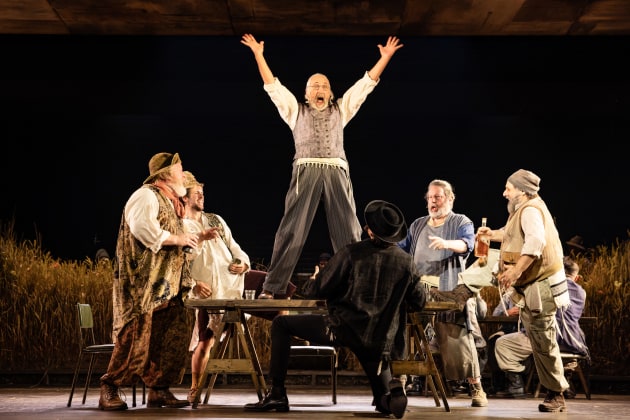
That sense of community is interestingly expanded in ‘To Life’. While modern audiences may understandably struggle with the premise of a young woman being promised in marriage to a considerably older man - no matter how charming John Waters, playing the prospective groom, is - the celebratory tavern dance is something quite special. More than simply a drinking song and dance, it becomes a rare moment where the Jewish villagers and their Russian neighbours occupy the same space in mutual celebration. Skilled dancers and character actors alike contribute to a sequence that embraces the primal nature and joy of movement.
The production reaches delirious heights during ‘Tevye's Dream’, staged as a full-throttle fever dream that unleashes the entire company in a thrilling explosion of theatrical imagination. It is bold, strange and enormously entertaining.
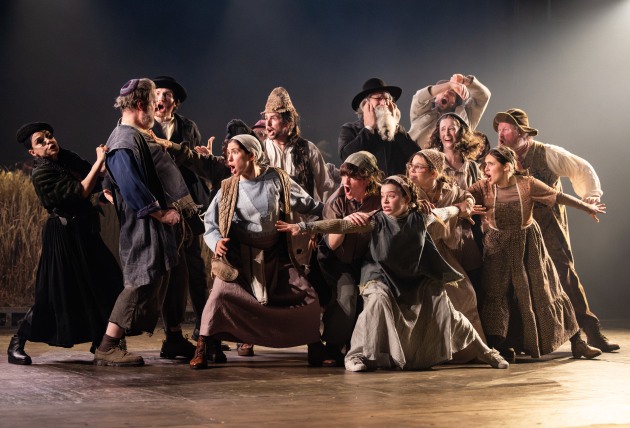
Then comes Jerome Robbins' legendary Bottle Dance, and it remains every bit the showstopper its reputation suggests. Precision, balance and bravado combine to produce one of musical theatre's most iconic sequences. The audience cannot help being swept up in the exhilaration of it all, making the abrupt shift to the so-called "demonstration" (really a euphemism for a pogrom) by the Russians all the more devastating. The Act 1 closing lands with genuine force and sends you to interval with a chilling effectiveness.
If there is one area where the production feels slightly undernourished, it is in the central romances. The story rests upon the choices of Tevye's daughters, whose desires challenge expectations and reshape their family's future. While the awkwardness of the courtships is often comical, there could be more space for the emotional connections to breathe. Given the potential consequences, a stronger sense of undeniable longing would heighten the stakes and increase the impact.
Similarly, one of Theatre Royal Sydney's greatest assets is its intimacy, and there are moments when the direction seems calibrated for a significantly larger venue. Some scenes would benefit from a more understated approach, trusting the proximity of the audience rather than projecting beyond it.
For today’s audiences, Fiddler on the Roof inevitably arrives carrying broader geopolitical resonances. Rather than shy away from it, I hope that audiences will embrace theatre’s role in providing opportunities to examine ourselves through stories set elsewhere and elsewhen. The displacement, prejudice and uncertainty experienced by the people of Anatevka continue to provoke reflection, even as the perspectives of who the persecuted are continue to evolve.
This production also makes several bold interpretive choices that may divide purists. Personally, they are among its most rewarding elements. The decision to avoid defaulting to a homogenised British accent acknowledges that there is no single "neutral" theatrical voice. Likewise, the addition of Chava's instrumental duet and the altered final image leave a powerful lingering impression of what is lost, remembered and carried forward.
Traditionalists may resist these departures. Yet challenging tradition (“Traditiooooooooon. Tradition”) is precisely what Fiddler on the Roof is about. Beneath its famous score, its humour and its beloved characters lies a story of people grappling with change while trying to hold on to their humanity. This production embraces that tension wholeheartedly, and as a result feels vibrant, moving and thought provoking.
- Heather Campbell
On the Choreography
Dance was, unsurprisingly, central to the production’s success, although the results were uneven. The cast is clearly strong, but some of the ensemble dancing, particularly among the men, lacked the sense of reckless abandon that this style needs. In ‘L’Chaim’, the movement felt slightly underdeveloped, with physical strength sometimes standing in for the weight, attack and earthy gusto of the folk-derived choreography. By contrast, Jerome Robbins’ original Bottle Dance was superbly executed and remained the dance spectacle of the evening, while the wedding sequence as a whole showed the company at its most assured. ‘Tevye’s Dream’ was another highlight, with energetic, sharply syncopated ensemble work and an impressive ease with comic movement, which is far harder to achieve than it appears. Elsewhere, those familiar with Robbins’ original choreography could often see a clear distinction between inherited and newly created material. That contrast was not always detrimental. Some playful references to contemporary popular dance had charm, and in places highlighted the lineage between traditional folkloric movement and the steps and rhythms that continue to surface in modern dance forms. Overall, the choreography used the stage and full company intelligently, but greater looseness, weight and abandon would have given the dancing more of the visceral force the material demands.
- Olivia Weeks