

Australasian Dance Collective
“Three”
Brisbane Powerhouse
July 15
Australasian Dance Collective’s triple bill program, simply but succinctly titled Three, is back after a two-year hiatus. Conceived in 2021 as a vehicle for creative risk-taking, this, its fourth iteration, promised again to showcase new works that not only champion choreographic voices but also display the technical skill and collaborative adaptability of the ADC ensemble of six dancers: Jack Lister, Sam Hall, Lilly King, Taiga Kita-Leong, Lily Potger and Te Atawhai Kaa.
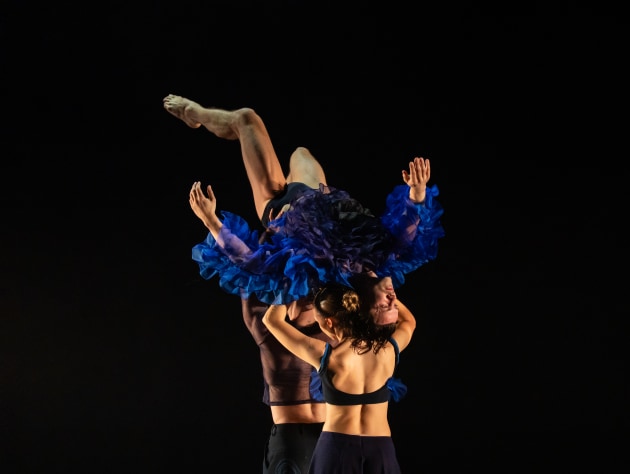
The program, comprising two world premieres bookending a work new to Queensland audiences, begins with Joel Bray’s Maarung. Meaning ‘circle’ in Bray’s native Wiradjuri language, Maarung sets out to explore the dominance of circles in nature and in the habitual circular repetitions present in our lives.
Accompanied by a sonorous, throbbing soundscape (Louis Frere-Harvey), the work begins with the dancers, in an assortment of individually styled black and blue patterned tops and pants (Bethany Cordwell), rotating as a fluidly shifting mass centre stage. One by one, each dancer is then lifted by the others into a prone position overhead. The movement, still very much of the upper body and arms, builds, the dancers moving in and out of unison, creating some recognisable references to the endless nature of circles.
Conceived using the tool of improvisation, Maarung still sits in that space in performance, according to program notes. While this promises the potential for renewal in each performance, it also risks a lack of attention to the choreographic structure, which, in parts, was absent here.
The work, however, comes together more in its final, quite mesmerising moments of slow-motion, amorphous movement, bodies connected and intertwining. Sounds of running water and birdsong accompany the fading light, leaving the dancers backlit by a single spot.
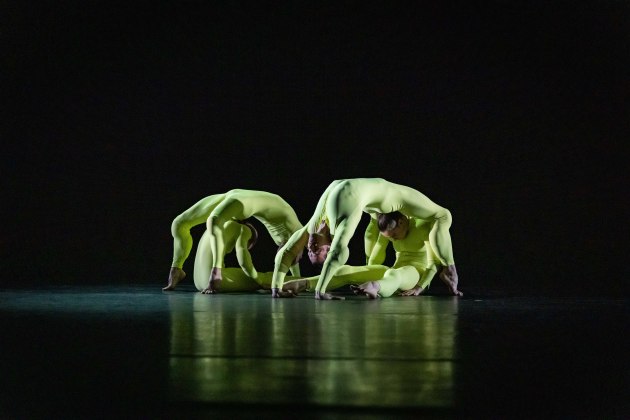
The other world premiere and closing work, Brog, was conceived and choreographed by Amber McCartney, whose award-winning Tiny Infinite Deaths was a highlight of ADC’s 2024 triple bill. McCartney’s practice includes the incorporation of prosthetics to create augmented, foreign bodies, blurring the line between human and alien. Here, in another design by Cordwell, the ADC dancers are dressed neck-to-ankle in white unitards, sometimes lit fluoro yellow, that bulge at the shoulders, elbows and knees, rather resembling car crash dummies.
Low overhead lighting (Ben Hughes) and an insistent soundscape (Alisdair Macindoe), like a cacophony of crickets, support what McCartney describes as a small evolving ecosystem of bodies. The movement is slow but detailed. The six dancers meld into different amorphous shapes, splitting from a tight collective into smaller groupings.
Intellectually, this was fascinating to watch but wasn’t viscerally engaging, apart from an intriguing solo moment by Kita-Leong of extraordinary loose-limbed, disembodied movement.
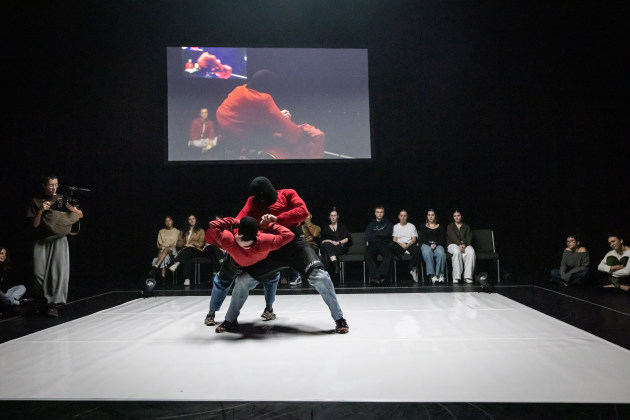
The middle work, Cuddle, was the most fully realised of the program. Conceived and choreographed by guest artist Harrison Ritchie-Jones, who, with Michaela Tancheff, also performed, Cuddle is an almost absurdist duet, cleverly framed as both a dance heist and wrestling match. The performance space is suitably arranged to support a wrestling ring concept, with the audience seated or standing on all four sides.
A short, pre-recorded video projected onto three surrounding screens shows the two balaclava-clad performers approaching the venue before they actually tumble, locked in an embrace, into the space.
Talking into handheld mics, their amplified, distorted dialogue is amusing, albeit nonsensical, and a catalyst for each round of physical sparring. Here we see wrestling refined and reimagined, where Tancheff is tossed by Ritchie-Jones over, around and under his body with an effortless fluidity. The extraordinary partner work is later embellished with moments of Riverdance and disco moves, as the two combatants gradually remove layers of clothing, revealing them topless in their underpants, socks and sneakers. The balaclavas, however, remain, maintaining the performers’ anonymity.
The entire proceedings are projected live by cinematographer Babi Bertoldi onto the screens, adding another dimension to a work that was certainly a crowd-pleaser, although a little long and overly repetitive in some of its later movement phrases.
Although a mixed bag, Three once again fulfilled its brief as a fertile vehicle for creative risk-taking. Undoubtedly, this season will spur further development and performance opportunities, with Cuddle already scheduled for the Gold Coast’s Bleach Festival 2026.
- Denise Richardson