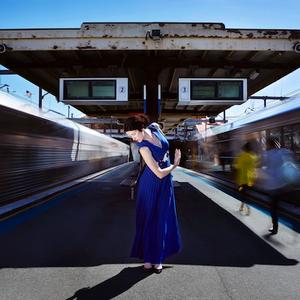
Sydney-based independent choreographer, Martin del Amo, is known for his quirky, idiosyncratic work. In fact, one could describe one of his life choices as idiosyncratic too. Whilst so many Australian dance artists choose to live in Europe, at least for a time, German-born del Amo has followed the reverse path. “I came to Australia [from Germany] for the first time in 1996 to collaborate on a project by Body Weather practitioners Tess De Quincey and Stuart Lynch, with whom I had worked on several productions in Europe,” he recalls. “I fell in love with the vibrancy and diversity of Sydney’s contemporary dance and performance scene. For a few years, I divided my time between Sydney and Berlin. In 2002, I eventually based myself in Sydney permanently.”
Until recently, del Amo worked predominantly as a solo artist. “When starting to make my own work around 1997, going solo seemed to be an obvious choice,” he explains. “Solos are cheap to make and you don’t run into scheduling difficulties with others. Of course, I was also interested in the artistic challenge that creating/performing solo poses. As a solo performer, you are asking your audience for their undivided attention but this attention, I believe, has to be earned. The big question is: How do you keep the audience engaged at all times? If you don’t, they lose interest very quickly.”
In the last couple of years, del Amo has begun to work with others too, but retains special affection for the solo. “A few years ago, I began to extend my practice to choreographing works for others, both group pieces and solos,” he says. “The solo, though, remains my favourite form, to which [my latest work] Slow Dances For Fast Times clearly attests.”
Slow Dances for Fast Times is about to open at Sydney’s Carriageworks, and, is, as del Amo has indicated, all about solo work. “Slow Dances For Fast Times consists of 12 short solos performed by 12 different dancers,” says del Amo. “The premise of the work was to create the dance equivalent of a concept album, bringing together individual pieces under a singular, unifying idea – short solos set to recorded tracks.”
Although there is a “unifying concept”, it’s the differences that are the focus of Slow Dances for Fast Times. “The work is designed as a collaboration between the solo performer and myself in the creation of a unique choreographic portrait,” says del Amo. “Each piece is set to the length of a recorded track and encapsulates a single choreographic idea that has been developed with the dancer. Each piece differs radically in style, feel and look as the selected dancers are from distinctive cultural and artistic backgrounds, from different ages, of different physicalities and from different states (Victoria and NSW). All pieces are performed against the sumptuous background of a large velvet curtain.”
And the title? What does that mean? “It is to be taken metaphorically, “ replies del Amo. “Not all the solos are, in fact, slow. It is more that they represent a point of difference in an environment of perceived sameness and conformity - mini-acts of solitary defiance, celebrating individuality.”
Each solo is created to a “hit song”, and del Amo explains why. “In some ways, Slow Dances For Fast Times is an extension of a strand of work that I developed when working as a solo artist. In addition to presenting full-length works fusing dance and intimate story telling, I also used to regularly perform short solos set to pop songs. This allowed me to show work outside of the conventional dance presentation circuit – in clubs, at parties, short works nights and festivals.”
It’s not just about broad appeal though, but about evoking memory. “The great thing about performing to popular music is that many of the songs are instantly recognisable and each audience member will have a direct connection with them, depending on their own personal experience of the song. It might, for example, trigger memories of a first kiss, a drunk late night dance with friends in a club somewhere, or even just serve as a reminder of where you where when you first heard the song,” says del Amo.
The cast, which is made up of Sara Black, Jade Dewi Tyas Tunggal, Benjamin Hancock, Raghav Handa, Julie-Anne Long, Sean Marcs, Jane McKernan, Kirk Page, Elizabeth Ryan, Luke Smiles, Vicki Van Hout and James Welsby is diverse in terms of age, and cultural and artistic background. “I was interested in bringing together a group of dancers who would represent the adventurous, open-minded approach to collaboration that, I feel, characterises the independent dance sector in Australia,” comments del Amo. “Some of the dancers, I’ve known for many years but never had the chance to work with. Other dancers, I didn’t really know personally but had seen their work and admired it. This project was a great opportunity to initiate acollaboration with them. In some cases I chose the dancer first and then tried to find the right song for them, in other case I had a specific song in mind and was trying to think who would be the most interesting dancer to interpret it. In matching a dancer with a song, I was often guided by a what-if-kind-of-curiosity. What if Luke Smiles would dance to Blondie’s "Sunday Girl", wearing a red dress? What if Vicki Van Hout would perform to Jimi Hendrix’s "All Along the Watchtower", clad in a men’s business suit? What if Julie-Anne Long would interpret one of my all-time favourite ABBA-songs, "The Day Before You Came?"”
Those questions and more will be answered when Slow Dances for Fast Times plays at Carriageworks, 6-9 March.