

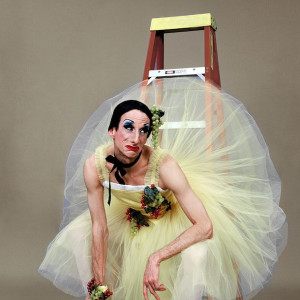
Our columnist Matthew Lawrence shares some tips on how to deal with the ignorant.
Ballet -- actually dance in general -- is riddled with misconception and stereotype. Society, on the whole, finds our art form simultaneously beguiling and confusing. The mystery and the other-worldliness of dance that make it so surprisingly enticing also make it alienating and perplexing to some. Thus those uninitiated, or newly acquainted to dance, place dancers in lazy, ignorant boxes: “You’re a dancer, which makes you this, that, and the God-forbidden other.”
So here is my guide, for students, professionals and balletomanes, to answering all those ignorant, ill-informed, annoying, frustrating, stupid, and just plain dumb questions you will be asked at parties.
1. Q: What is your full-time job?
People will be fascinated to learn that as a professional dancer you can work up to 40-60 hours a week – depending on whether it is a performance or rehearsal schedule. It is often assumed that dance is like an amateur sport, where you train after work. And besides, how could dance possibly be a real job?
A: Professional dancers work a 40-60 hour week, let alone the unpaid overtime of sewing pointe shoes (darning – stitching around the pointe – can take 30 minutes a pair), pre-show preparation (make-up, hair, warming-up), gym-work and pilates.
2. Q: (Asking a professional dancer) Are you still dancing at that school?
Again, this closely relates to the former question, when it is assumed that dance is a part-time vocation. A relative of mine insists on asking this question every – thankfully infrequent – time we meet. I mean seriously, I am 38! That would make me the oldest student at ballet school by about 20 years.
A: I am a dancer with a ballet company, which although is often attached to a school (example: the Australian Ballet School is located in the same building as the Australian Ballet), is a full-time, paid position. Therefore I am not a student.
3. Q: Do you call male ballet dancers ballerinas?
This question is particularly common, insulting and emasculating. It conjures images of men in tutus, tiaras and pointe shoes – a role already, willingly taken, by the pantomime company, Les Ballets Trockedero de Monte Carlo. Ironically, part of the ‘Trocks’ cross-dressing “drag-gag” is playing on the audiences general ignorance of what role the male ballet dancer plays.
A: A ballerina is a term used for female ballet dancers. The word’s origin is Italian, originating from ballare (to dance); ballerino (dancing master); ballerina (feminine of ballerino). The masculine version, ballerino, never stuck thankfully. Therefore the expression “male ballet dancer” or “male dancer” will suffice.
4. Q: (In reference to the man) How do you guys stand on your toes?
Just the other day, I was asked this question, even after the inquirer had watched the ballet. One could, I guess, almost take this as a compliment. After all, a high arched demi-pointe is sought after.
A: Men wear flat slippers – similar to martial art shoes – that mould to the wearer’s foot. As a rule, only ballerinas wear pointe shoes; the exception to this being in comic roles, such as Bottom in The Dream and the Ugly Sisters in Cinderella.
5. Q: Are most ballerinas anorexic?
In truth this is a tricky question, because ballet’s track record with eating disorders is not great. However, it would also be an exaggeration to say there’s an epidemic. Helen Law’s book, Fit to Dance 2, is arguably the most comprehensive report into the health of dance companies. Her research published in 2005 (based on UK dance companies) found that nine per cent of professional ballet dancers, and 19 per cent of vocational dance students, had some form of eating disorder (ED).
A: Anorexia is just one, very visible, form of eating disorder. More common, and harder to diagnose, is bulimia and Eating Disorder Not Otherwise Specified (an ED which is not anorexia or bulimia). It is fair to say that no-body really knows how prevalent EDs are in dance. However, most dancers, through early natural selection, show ectomorph qualities; they are naturally slim - and fitter than a truck-full of over-paid, celebrated footballers. (Talking of sports, there is also a high prevalence of ED's within the aesthetic sports - gymnastics, figure-skating, synchronised swimming and diving - yet, curiously, this rarely makes the news.)"
s
6. Q: Do the men pad their jocks?
After a few drinks, you will always find someone silly enough to ask this question. The only occasion in which one might “shape” their support is when wearing light-coloured tights, where some dancers double-jock. Therefore sparing the audience from viewing, as one ballet master put it, “Percy and the twins”.
A: No (Just keep it short).
7. Q: Are all male ballet dancers gay?
At a party recently, upon learning my profession was a ballet dancer, the gentleman walked away -- as if being in my presence might compromise, or bring into question, his sexuality. Even though I have a wife and child, my association with dance will always put me on the suspicious list. Ballet dancers certainly experience homophobia. From bullying at school to sniggering adult blockheads, it is cave-man ignorance that leads to lazy boxes.
A: Proportionate to most occupations, there is probably a larger ratio of gay to straight. But I would hope, in our modern, sophisticated, tolerant and educated society, it would not really matter.
This article first appeared in the February/March 2015 issue of Dance Australia.
Buy it at your favourite retail outlet or purchase online by downloading the Dance Australia app here.