

The poet Robert Frost once wrote, *“A poem begins as a lump in the throat, a sense of wrong, a homesickness, a lovesickness…”*¹
For a choreographer, Frost’s lump in the throat, or urge to create, can be triggered by almost anything: a painting, a story fragment, a relationship, a piece of music, a sunset, a scene at a crowded train station. Or indeed a number!
One trigger for choreographer Trà Mi Dinh’s latest work is the number seven. “It just sort of speaks to me,” she says, “whilst also really tickling the logical dance nerd part of my brain that just wants to work with counts!”
Seven Dances for Seven People is Dinh’s second work inspired by that numinous number. In 2024, she created Seven Dances for Two People, a 20-minute commission from Lucy Guerin Inc.
For that commission, Dinh says she sought a clear and simple idea that she could explore in a variety of different ways, like a study: “one that felt both emotional and mechanical.”
But whereas poets, painters and composers can immediately get an idea out of their head and heart by writing it down, a choreographer often requires an opportunity: a space, some funding and, crucially, other dancers, to grab that idea at that particular moment and run with it.
British contemporary choreographer Wayne McGregor, who has spent more than 30 years creating work for his own company, Company Wayne McGregor, and major dance companies around the world, has described a piece of choreography as a marker in time, a constellation of ideas and decisions that reflect a moment in your life and the world around you.
Dinh describes something similar. While her interests, or “obsessions”, remain constant, she sees what emerges for each new choreography as a confluence of things at a particular moment in her life. So, when a new opportunity arose, Dinh seized the chance to dive back into her interest in seven.
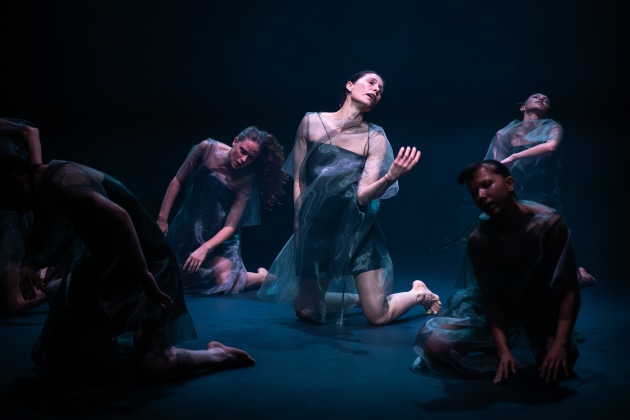
Dinh says she is very visual from the outset. At the beginning of Seven Dances for Seven People, she imagined reflective costumes that would play with the light, tricking the eye as to “whether they’re there or not there”, creating a transparency of sorts. Whether or not these initial ideas make it into the final design, she says she is immediately thinking about atmosphere, lighting and what the colours feel like. Such visual cues help her find her way in.
“I’m a big fan of Pinterest,” she says. “I love pinning things on my board that are to do with the feeling of the work: things like textures from nature or material things, but also things that are architecturally inspiring for me, like lines and space.”
Pre-Pinterest, the published notebooks of pioneering 20th-century choreographer Martha Graham (1894–1991) reveal the brainstorming part of her creative process. They are filled with ideas, references and scrawled choreographic notation spanning her ground-breaking works from the 1940s through to the 1960s and showing her recurring influences and numerous literary sources.
For Dinh, the creative impulse is ultimately physical: discovering how the ideas live in the body and can be expressed through movement. She often begins alone, through improvisation. “That’s me finding the textures of the feeling or what kind of states can be brought about by my concepts,” she says.
McGregor describes this moment as building the physical language for the world you are trying to create. Renowned for working fast, he describes walking into that empty studio as the daunting part. For him, one way into creativity is through speed: working quickly knocks away the preconceptions, and perhaps any inhibitions, about what you think you are going to do.
His movement-generating process is one of “transference”, whereby a stimulus or idea moves from one body to another. In his 2013 TED Talk, you can watch this process in action: the dancers grabbing morsels of his movement ideas and, in the moment, adapting them to their own bodies and filtering the movement through their individual creativity and physical archive.
For Dinh, making movement can be a whole gamut of different things depending on the work in question. With Seven Dances for Seven People, she played rhythmically to find new accents in a mathematical, structured way. But she also used more esoteric cues, such as pursuing the feeling of perfect wholeness derived from the number seven, finding movements based around the throat inspired by the seven chakras, and using story-based cues drawn from the seven Pleiades sisters.
Martha Graham’s movement explorations pioneered a whole new technique practised to this day. But it all began with her just trying to find herself, what the body could do, and what would give her satisfaction emotionally, dramatically and bodily. She put it simply: *“Dancing is just discovery, discovery, discovery - what it all means, the way the little bone near the ankle relates itself to the floor for a perfect stance, a perfect plié.”*²
But choreography is also collaborative. “I don’t love being on my own,” Dinh confesses. “I love the reciprocal exchange between dancer, choreographer and collaborators.”
Dinh likes all hands on deck in the space together from the get-go, particularly her composer, Tilman Roberts, because the score feeds the work so heavily. Working together, Dinh says, is a conversation, with each collaborator zooming out from their singular role to remain conscious of the work as a whole.
Some collaborations become lifelong, such as Graham’s 30-year working relationship with designer Isamu Noguchi. He came to expect her 2 a.m. phone calls whenever a new project was brewing. In her autobiography, Graham wrote: *“Isamu walked and directed our blood memory. He took me to images that I had never contemplated before and gave new life to works I had created.”*³
With all this making and generating, you can end up with mountains of material to be organised, crafted and culled. “A lot of crafting is done in the nitty-gritty of rhythmic relationships between different groupings or different approaches to a certain piece of movement,” says Dinh. “Then zooming out and getting the right feel for the whole atmosphere.”
She finds it helpful to work with dramaturg Samara Hersch from the outset in considering a work’s trajectory, followed by regular check-ins to keep an eye on its arc and the audience experience.
At the time I interviewed Dinh, she had just given herself a weekend off for some much-needed mental space. She was “in the weeds”, that moment when you are so deep inside a work that perspective becomes difficult. Dipping your toe back into normal life helps, but “the only way out is through,” she says.
With just under four weeks’ development time split between January and September before the two-week run, Dinh says it feels tight. “Having so many incredible artists in the room is so exciting, and it kind of makes me jealous that I don’t get to have more time with all these people to really get into the thick of it of what the potential of this work could be,” she says.
But while a deadline is a line in the sand, how do you know when a work is done? “When it feels right,” says Dinh. “It’s when it feels right in the gut, and it’s when I feel excited by it.” Yet at the same time, she suggests live performance is never fully finished, “because so much exists in the live performance of it.”
By Emma Sandall
Emma Sandall is an Australian dance artist, writer and teacher who danced with The Royal Ballet and Béjart Ballet Lausanne.
Trà Mi Dinh presented Seven Dances for Seven People at Northcote Town Hall Arts Centre, 10–19 September 2026.
For Your Interest
-
Robert Frost, quoted in Alice Major, Intersecting Sets: A Poet Looks at Science (Edmonton: University of Alberta Press, 2011), p. 2.
-
Martha Graham, “Martha Graham Reflects on Her Art and a Life in Dance”, The New York Times, 31 March 1985.
-
Martha Graham, Blood Memory (New York: Doubleday, 1991), quoted in Natalie Ginsberg, “A Dance Across Time: Martha Graham and Isamu Noguchi’s Embattled Garden”, The Noguchi Museum.
This article first appeared in the October–December 2026 issue of Dance Australia.