

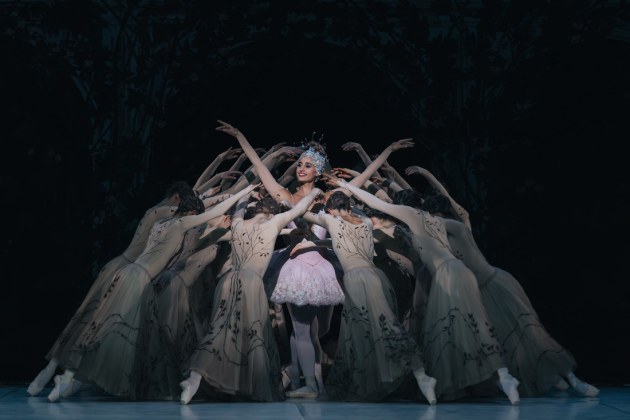
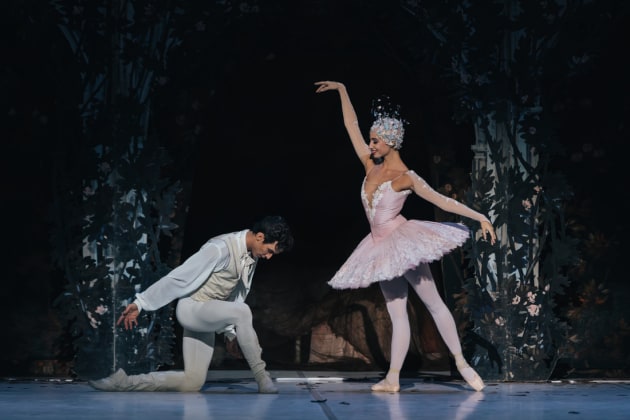
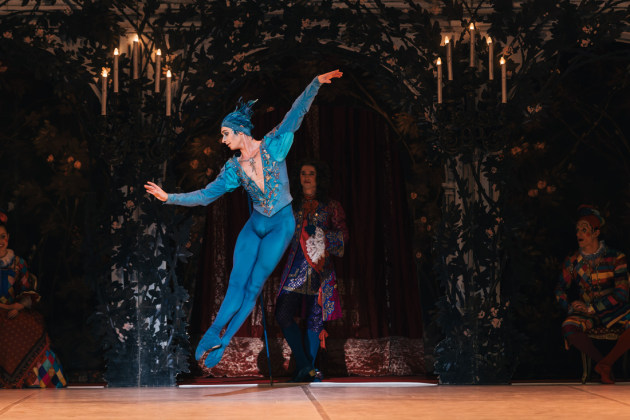

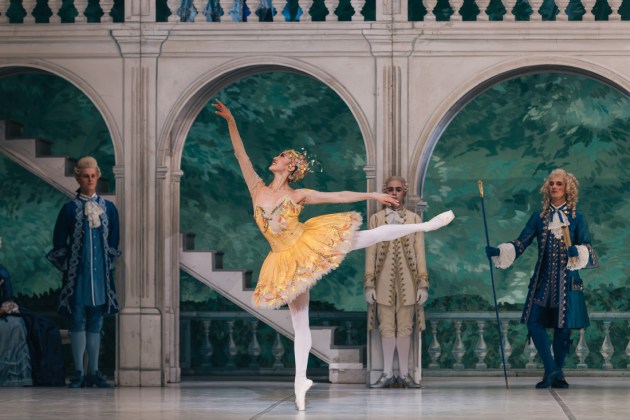

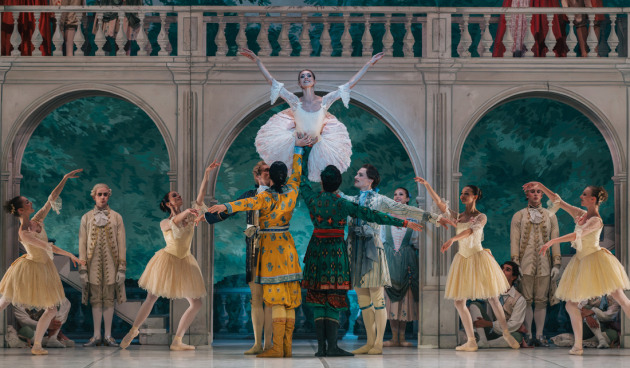
For many, the Stuttgart Ballet is synonymous with the choreographer who brought it international acclaim, John Cranko. However, it was, in fact, not Cranko but one of his prima ballerinas, Marcia Haydée, who was responsible for creating one of the company’s most acclaimed productions – Sleeping Beauty, which will be touring to Melbourne in October. Haydée’s Sleeping Beauty, which premiered in Stuttgart in 1987, combines the timeless Tchaikovsky score with iconic décor and costumes by Jürgen Rose, the set and costume designer who worked closely with John Cranko throughout his life.
What makes this Sleeping Beauty special is how closely Haydée followed Marius Petipa’s original 1890 production when creating her 1987 version, undertaking extensive historical and archival research in the process. In a 2022 interview with Angela Reinhardt, Haydée explained that she had “watched many videos and tried to find the version that came closest to the original”. She also worked with the Bolshoi ballerina Olga Lepeshinskaya on the history of the ballet.
“There’s no need to change what Marius Petipa choreographed, because it’s perfect as it is!” Haydée has said.
This tour will be the first time that Haydée’s version, created by a prima ballerina and influenced closely by two ballet greats – Petipa and Cranko – will be performed in Australia.
When Haydée’s Sleeping Beauty premiered, Germany was in the midst of a boom in experimental Tanztheater, an expressionist style of dance blending contemporary movement, everyday gestures, spoken text and impactful stage design. For Haydée, an “old classic” like Sleeping Beauty presented an opportunity to re-engage with the archive, motivated by a belief that “classical technique is the most important foundation of ballet” and that “choreographers should never forget the past”.
As a result, Haydée returned Sleeping Beauty to its Russian roots, reviving the original emphasis on the roles of the Lilac Fairy and Carabosse (for those interested, the 1890 premiere of Sleeping Beauty featured Marie Petipa, the daughter of Marius, as the Lilac Fairy, and Enrico Cecchetti as Carabosse).
In an interview with Stuttgart Ballet dramaturg Lucy Van Cleef, conductor Jonathan Lo spoke about how, during the period of creating Sleeping Beauty, Tchaikovsky was interested in ideas of good versus evil and “in the unseen forces that act on human lives”. This interest played out in his creation of leitmotifs for the characters of the Lilac Fairy and Carabosse, symphonic representations of the constant presence of good and evil forces in our lives.
Haydée’s version of Sleeping Beauty returns to this original focus, transforming Carabosse from a purely dramatic character into a leading dancing role.
“The most beautiful, powerful music is Carabosse music”, Haydée has said. “If the company has a Carabosse, I will do Sleeping Beauty, but if a company doesn’t have a Carabosse, I will not do Sleeping Beauty.”
In anticipation of this piece of ballet history coming Down Under, I spoke to two dancers from the Stuttgart Ballet who will be bringing the ballet to life for Melbourne audiences – Principal Artists Elisa Badenes and Henrik Erikson. Both Badenes and Erikson have performed Haydée’s Sleeping Beauty before and will be performing as Princess Aurora and Prince Désiré in the Australian tour.
Elisa and Henrik are on lunch break when I speak with them. The pair have been rehearsing John Cranko’s Onegin, which will open in Stuttgart in a few days, the first run of performances since the company returned from summer break a few weeks ago. They will have four shows of Onegin before packing their bags and flying to Melbourne for the company’s Australian tour.
This is the first time the Stuttgart Ballet will tour to Australia as a full company in 52 years, following its last Australian tour in 1974, a year after the sudden death of John Cranko, the artistic director and prolific choreographer who built the company into one of international acclaim. Now, the company returns with Haydée’s Sleeping Beauty.
Belle Beasley: Could you tell me what you feel is special about Marcia Haydée’s Sleeping Beauty compared to other versions?
Henrik Erikson: In Marcia’s Sleeping Beauty, especially, Carabosse has a big role. She’s kind of telling the whole story. In other versions it’s mainly the Prince and Princess as the main couple, but in this version Carabosse is also very strong and involved in the whole piece.
Elisa Badenes: I think it’s very special to bring Sleeping Beauty, especially Marcia’s Sleeping Beauty, because it’s a production that is very popular. So many companies have a Sleeping Beauty version. What is characteristic in this one is that it represents so much of our company because it’s a classical ballet, it’s really a classical ballet, but like Henrik said, what is special is the characters, how they are represented in the ballet. They are very strong, like the storytelling through Carabosse. All of them, they are very humanized. It’s a fairy tale, but definitely the characters are very well portrayed, and then of course, with the Jürgen Rose costumes and sets, the whole ballet shines to the max.
BB: Yes, it’s visually such a beautiful ballet. I feel it’s almost a Pinterest ballet – like I want to save images of it for bedroom decoration or something.
EB: When you think of a Sleeping Beauty, like others I’ve seen and danced, it’s all about royal and shining and crowns. But Jürgen Rose makes it more human too. The crowns are very tiny, and the Princes are real people. I think for the Prince roles it’s the best version. Normally they dance in heels and wear weird wigs. In Haydée’s version, the Princes are powerful. Every Prince is from a different region, so they dress differently. I think it matches what the company feeling is about at Stuttgart. That we focus on the characters and telling the story in a very human way.
BB: Is this focus on characters something that you associate with Marcia’s style?
Elisa: Yes, but not only in terms of Haydée, but also in terms of Cranko. I would say that the main theme of the Stuttgart Ballet, like what we want to portray, is that the characters are very important. We are dancers but we are also actors. Both sides match. You cannot be a dancer without being able to portray your character properly.
BB: The ballet was created much before either of you joined the company. Do you have any stories from being in the studio and hearing stories from the original creation of the ballet?
EB: It’s funny that you mention that. Actually, Marcia is a lot with us in the studio, so that’s very beautiful because we have actually the choreographer there coaching us. The special thing about her is that she likes individuality. So, she looks at you and the way you do things, and it’s like, ‘I like that, so for you it’s better this way.’ She never takes the first person that did the role and says, ‘that’s the way it has to be’, because everybody’s individual and everybody brings their own quality to it. I think that’s special. And then, for the guys, our current director Tamas actually was one of the main Princes.
HE: Exactly, yes. Tamas was actually like the first Prince Désiré. (Laughing) So, he coaches us a lot, because he knows the choreography exactly.
EB: (Laughing) He’s more like this is the way. Yeah, it’s really special for us to be able to work with the first-cast Prince and the choreographer. It’s a super-close process, like hand in hand. I think we’ll bring something different to each show. So, you could watch all the casts, and all the casts will bring something different to the table.
BB: Do you have any special memories of working with Marcia?
Elisa: She’s really amazing and very sweet too and funny. We’re always laughing. She’s very active, she is always walking around the studio pulling your tutu, being like ‘no, don’t go yet’, or with the Prince being like ‘look at him, look at him’. She’s really involved while you’re dancing.
BB: Will it be both of your first times in Australia?
HE: For me it’s the first time.
EB: For me it’s not. It’s the fourth time. I know. A long time ago, I would say 15 years ago, I went for the first time to do the gala for the 50th anniversary of the company of The Australian Ballet. I went with Daniel Camargo and I was really young, probably like 20. After that, the company invited us both to dance with them in Don Quixote and La Bayadère, in Sydney and in Melbourne. So, for me, it’s like coming back. It’s really, yeah, it feels like another life. So long ago.
BB: And I suppose it’s a little bit different to come with the whole company, not just solo?
EB: Exactly. This time with our company, with a company production. I think that’s very special.
By Belle Beasley
This article is featured in the October–December 2026 issue of Dance Australia, available now.
Marcia Haydée interviewed by Angela Reinhardt, 2022. Courtesy Stuttgart Ballet.
Jonathan Lo interviewed by Lucy Van Cleef. Courtesy Stuttgart Ballet.
Elisa Badenes and Henrik Erikson interviewed by Belle Beasley for Dance Australia, 18 September 2026.