

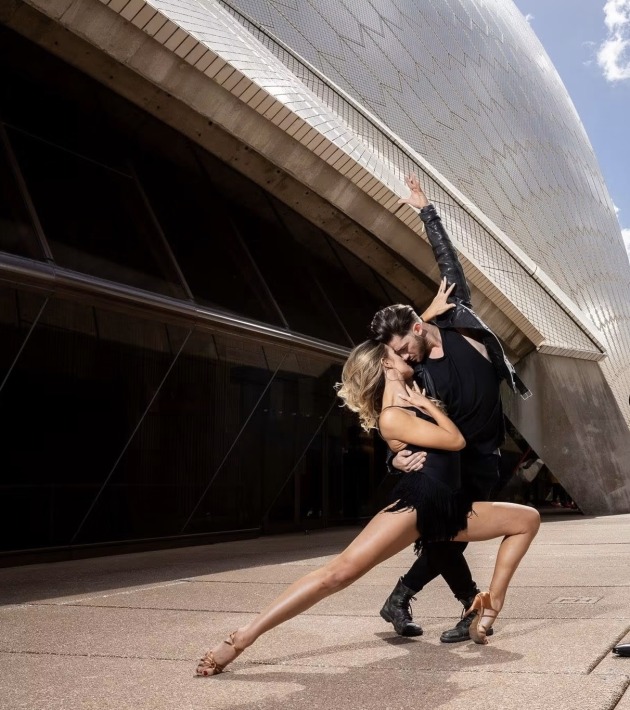


Jorja Freeman was 19 when she first walked into a Burn The Floor rehearsal room. She remembers feeling intimidated, star-struck and completely out of her depth. Gustavo Viglio arrived from the competitive ballroom world, successful but ready for something beyond marks, rankings and technical perfection.
For both of them, Burn The Floor became the place where professional life began properly. It was their first job as dancers, but it quickly became much more than a contract.
“At the time, I had no idea just how much it would shape my life,” Freeman says. “It taught me how to be an adult, a better performer, a stronger professional, a more creative thinker and, perhaps most importantly, a better person. It has given me so much more than a career in dance. It has given me lifelong friendships, incredible opportunities and a sense of purpose that continues to evolve every day.”
Viglio’s memory is tied to a different kind of release.
“I was leaving for something different, something where I could be myself and not go out to be judged,” he says. “Burn The Floor, although I didn’t know it initially, has been where I have found my voice.”
Ballroom and Latin dance are often seen through competition or television, both of which bring their own pressures. Burn The Floor keeps the technique, speed and partnering those forms demand, but sends them in another direction. On this stage, the dancers are not performing for marks. They are trying to reach the audience.
For Viglio, that was the biggest adjustment.
“Learning to dance for myself instead of for a judge was definitely the biggest adjustment,” he says. “For so many years, dance had been about marks, results and trying to be technically perfect. Burn The Floor completely changed that for me. It allowed me to rediscover why I fell in love with dancing in the first place. Suddenly I wasn’t performing to be judged, I was performing to make people feel something. That completely transformed my relationship with dance.”
That is the energy Burn The Floor: Luminous will bring to Australian stages when the tour opens at the Sydney Opera House this month. For Freeman and Viglio, who have both grown up inside the company in different ways, this new production feels charged by the past without being held by it.
Freeman says Luminous still has what audiences expect from Burn The Floor: passion, athleticism and connection. But she feels the show has been reworked for the present.
“We’ve fused iconic music with some of today’s most exciting contemporary tracks, alongside revitalised choreography that breathes new life into the classics,” she says. “Personally, it’s made me feel like I’m 18 again, rediscovering myself as both a dancer and an artist. That’s incredibly exciting and, yes, a little daunting at times too. But that’s what growth should feel like.”
There is, she says, a sense in the rehearsal room that the company is actively building its next chapter.
“This cast is such an eclectic mix of extraordinary artists that every rehearsal feels like we’re creating something genuinely unique and special.”
Viglio feels the same push across the whole production.
“Everyone is wanting to break new ground,” he says. “Music, costuming, dance, scenic, everyone is wanting this to push forward in a new way and that’s a really exciting ride to be on.”
For Freeman, Luminous also brings a personal shift. She returns as a principal performer, but also as part of the creative and management team. The dancer who once felt overwhelmed in her first rehearsal is now helping shape the production from the inside.
“When I stop and reflect on it, it feels quite surreal,” she says. “I’ll never forget where I came from, and I’ll certainly never forget my very first rehearsal day with Burn The Floor. I was intimidated, completely star-struck and honestly felt so out of my depth. But I just kept showing up and working the only way I knew how, with everything I had.”
That steady accumulation of experience has given her a close view of Jason Gilkison’s creative process. Freeman speaks about him with the admiration of someone who has watched him work over many years, and is still learning from the way he draws performance out of dancers.
“Although we are dancers, he never simply directs movement, he creates people,” she says. “He places us into scenes, uncovers our personalities, understands what makes each of us tick and somehow finds a way to bring out something in us that we often don’t even know is there ourselves.”
Now she watches not only what he creates, but how he creates it.
“I watch how he runs a rehearsal room, how he knows exactly when to push and when to step back, how he structures a rehearsal day to get the very best out of everyone, and how every decision has purpose.”
That kind of leadership has shaped her own thinking about longevity. Freeman is clear that a career is not made by visibility alone.
“Longevity isn’t built on 15 seconds of fame,” she says. “It’s about what you do with those 15 seconds to create a career that lasts 15-plus years. Every single opportunity matters. No job is too small, no rehearsal is insignificant and no moment should ever be taken for granted.”
Leadership, in her view, is quieter than many young dancers might imagine.
“It isn’t about being the loudest person in the room; it’s about the example you set every single day. Work hard, be kind, stay curious and never stop learning. Every job is an opportunity, not a destination.”
Viglio’s lesson from Burn The Floor has been different, but no less formative. After years of being assessed against competitive ideals, the company gave him permission to bring more of himself to the stage.
“Individuality should always be celebrated because it’s what makes every performer unique,” he says. “One of the reasons I’ll always be so grateful to Burn The Floor is that it taught me that being myself, as weird, loud or wild as that might sometimes be, isn’t something I should hide. In fact, it’s exactly who I’m supposed to be. Audiences connect with authenticity, and Burn The Floor has always encouraged us to bring our whole selves to the stage.”
That is not a small demand. The show’s physical impact is obvious, but Freeman and Viglio both return to the emotional labour of it. Night after night, the dancers have to give the work heat, humour, vulnerability and scale without a spoken line.
“Burn The Floor has always demanded an incredible amount physically and technically,” Freeman says. “But over time those things become second nature. What never becomes easy is the emotional investment.”
Viglio puts it more plainly.
“Every single night we have to tell stories without speaking,” he says. “We have to make audiences laugh, cry, feel excitement, vulnerability and joy purely through movement. To do that, you have to be willing to go to emotionally exposed places over and over again. That’s the greatest challenge and also the most rewarding part of what we do.”
Away from the stage, Freeman and Viglio are husband and wife, though not the kind of ballroom couple audiences might assume. They work together, travel together and share the stage, but they do not dance together anymore.
Freeman laughs about it now.
“Gustavo and I actually don’t dance together anymore,” she says. “We gave it a good try many years ago, but it nearly caused us to break up. We realised very early that our relationship was much healthier if we kept our dance partnerships separate.”
Their first attempt was in London’s West End. It was memorable, but not for the reasons either might have hoped.
“We bickered constantly, teased each other relentlessly and drove each other completely mad,” Freeman says. “We lasted a couple of months before deciding we’d had enough. The chemistry was definitely there, perhaps just a little too much of it.”
Viglio is more direct.
“We hated it!” he says. “We could not understand how to split work with life and it was definitely a period we both remember and can laugh about now.”
They have since found a version of partnership that works. They can understand each other’s professional pressures without needing to share every role, rehearsal note or dance partnership. After rehearsal, the reset is often quiet. Viglio heads to the kitchen, where cooking gives him a different focus and a connection to home.
“I love cooking the meals my mum and my Nonna made for me growing up,” he says. “Whenever I do, it brings back those memories. It definitely helps with homesickness when we’re travelling.”
Dinner has become a kind of meeting point for them.
“We ask each other about our days almost as though we’ve been apart,” Freeman says. “Because our roles are so different, we’re able to give each other space even while sharing the same environment. That balance has become really important for us.”
It took years, she says, to know when to offer advice and when to let work go.
“We’re much better now at recognising when someone needs advice, when they simply need someone to listen, or when they need an escape from work altogether.”
Viglio believes the shared history deepens the relationship.
“We know how to support one another because we’ve lived the same highs and lows.”
Their admiration for each other is specific. Freeman describes Viglio as one of the most joyful dancers she has watched.
“You simply can’t help but smile when he’s on stage,” she says. “His passion is completely infectious, and it was genuinely one of the very first things that attracted me to him.”
Viglio points to Freeman’s intelligence.
“Jorja’s greatest strength is her mind,” he says. “She’s one of the smartest creatives and dancers I’ve ever worked with. She has this incredible ability to make choices that not only showcase her own strengths but elevate everyone around her. She sees possibilities that others simply don’t.”
That generosity does not feel decorative. It comes from years of seeing each other under pressure: in rehearsal, on tour, in performance and at home. It also mirrors what both say Burn The Floor has given them. Freeman found purpose, leadership and a creative future. Viglio found freedom from judgement and permission to be himself.
With Luminous, they are stepping back into a company that is still asking them to change.
Freeman hopes audiences feel that immediately.
“I hope audiences leave feeling like they’ve experienced something completely new,” she says. “I hope they’re excited, inspired and immediately want to come back and see it again because there will always be something new to discover.”
For her, the production continues the work Burn The Floor has been doing for more than two decades: expanding what ballroom can be, who it can speak to and where it can sit within the wider dance landscape.
“Luminous is the next evolution of that journey,” she says. “It celebrates where we’ve come from while showing that dance has no boundaries, that ballroom, contemporary, theatrical storytelling and iconic music can exist together beautifully to create something truly unforgettable.”