

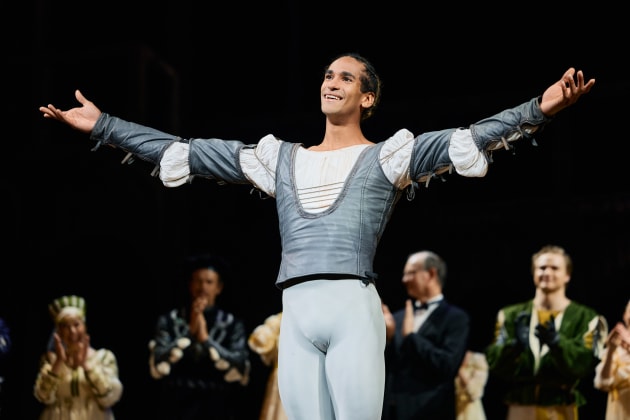
Davi Ramos: “I Love My Job and I Love My Life!”
By Daniel Gaudiello
Davi Ramos, newly promoted principal artist of The Australian Ballet and the first Black principal artist in the company’s history, spoke to me about the remarkable journey that has brought him from Brazil to one of the world’s leading classical ballet companies.
When we spoke, Ramos had recently returned from a demanding but rewarding stint with Hong Kong Ballet. He spoke with great warmth about Vladimir Malakhov, who has become something of a godfather figure to him. “He’s my mentor now,” Ramos says, recalling their time together.
In just 12 years, Ramos went from the beginning of his ballet training to principal artist. It is the kind of ascent that feels almost improbable, yet in conversation it becomes clear that his progress was built not on luck, but on instinct, discipline and an unusual degree of self-belief.
As a young boy, he was drawn to sport. His mother, herself physically strong and athletic, recognised in him many of the qualities that would later serve him as a dancer: muscle density, proportion, definition, coordination and natural flexibility. He loved football, and especially volleyball, which he was keen to pursue. He also took weekly capoeira classes with a teacher who worked him hard and saw his potential.
One evening, while Ramos was standing in the living room, his mother noticed that he had found his way almost naturally into first position. He was not aware of what he was doing, but she recognised something. She asked him to watch a ballet video. He was intrigued, and she soon found a local dance school where he could try classes for a week.
He was the only boy, and was placed in a level much higher than a beginner would usually enter. Still, he persevered. This was the beginning of his determination to thrive in an industry he was entering late, at 12 years old. His important early teacher, Lorena Boaventura, would become one of the people who helped shape those first years.
Ramos loved the music, but even more, he loved the discipline required in ballet. By the end of that first week, he had made his decision. He would give it a go.
His pathway was far from traditional. He went straight into tendus and jumps in his first week, rather than beginning with the careful, gradual progression most ballet students experience. His family did not have the money to pay for lessons, so the school provided shoes, clothing and training free of charge. He was pushed hard and fast. Within six months, he had advanced to the next level. Six months later, he moved up again. These were extraordinary leaps in a training system that usually takes years.
Ramos believes it was his confidence and fearless determination that carried him through. At 13, he travelled to Rio and asked to take class with company-level dancers. He found himself in a room full of artists in their prime, while he had only minimal technique. The teacher immediately noticed his fire and wanted to help him further.
He loved jumping. He loved turning. Partnering did not interest him much at first, though he has since developed into an exceptional and generous partner. In the beginning, he was simply excited to dance.
His days often ran from 10am until 10pm. It was an intense schedule, almost unimaginable in many training environments, but not unusual in countries where young dancers often work with extraordinary urgency. Ramos absorbed it.
A scholarship to a summer intensive in Barcelona became another turning point. There, he met students from The Royal Ballet School and was struck by their precision and quality.
“That’s where I want to go,” he remembers thinking.
When he returned to Brazil, he told his teacher, “I want to go to The Royal Ballet School.”
At 14, just two years after beginning ballet, Ramos competed at Youth America Grand Prix in New York and reached the finals in 2014. It was an extraordinary achievement. He was offered a scholarship to American Ballet Theatre’s school, and soon set his sights even higher: the Prix de Lausanne.
His first audition video for the Prix was of such poor quality that the competition asked him to film and submit it again. After receiving a stronger recording, he was accepted into one of the world’s most respected ballet competitions. Once again, his family had no money to help him get there. The mothers of friends helped fund the trip, and the competition assisted with travel and expenses. It is a moving detail in a career shaped by both personal drive and the generosity of others.
From the Prix de Lausanne, Ramos received 12 offers. Christopher Powney, then Director of The Royal Ballet School, offered him a full scholarship, including flights, accommodation, spending money and everything required for him to succeed.
When Ramos arrived in London, he was initially insecure about his body. His muscles were developing quickly, but in time he began to see strength as an asset. He wanted to become a powerful jumper, and he started to embrace the physical qualities that made him distinctive. Today, he speaks proudly of his legs as one of his greatest strengths. It is refreshing to hear a male dancer celebrate, rather than diminish, the attributes that give his dancing its force.
In his final year at The Royal Ballet School, he was selected to perform the principal role in the school’s end-of-year production of Paquita. Dancing on the Covent Garden stage was a major highlight, and an honour he has never forgotten.
Upon graduating, Ramos was offered a position with Dutch National Ballet at just 19. Surprisingly, he declined. He did not feel ready to join the corps de ballet and instead asked for a place in the junior company, where he could gain more stage experience. It was a remarkably mature decision. He understood the importance of not rushing the process, and recognised that becoming a truly accomplished artist takes time.
At Dutch National Ballet, one of his most important coaches was Guillaume Graffin. The company quickly recognised Ramos’s talent, and by 21 he was performing the lead role in The Sleeping Beauty with the main company. It was enormous pressure for a young dancer, yet Ramos says he never doubted himself. His passion for ballet outweighed the nerves.
He remembers aching muscles, endless gym sessions and Pilates classes, all of which helped strengthen him during those crucial years.
Eventually, his attention turned to Australia, and particularly to the opportunity to work under David Hallberg. He told his director he wanted to make the move.
At The Australian Ballet, Ramos felt welcomed from the beginning. On his first day, dancers invited him out for drinks.
“This is very different to Europe,” he says, explaining that friendships there can take much longer to develop.
After several months, he began to understand the cultural difference between the work ethic he had grown up with and Australia’s emphasis on balance. At first, it confused him. Now, he sees its value.
“We have balance here,” he says, adding that it was exactly what he needed.
Ramos is thoroughly enjoying Australian life: the social side of the company, the coaching, the supportive atmosphere and the sense of ease among the dancers. He speaks warmly of the artists, staff and especially Hallberg.
When he was younger, Ramos wondered whether his skin colour would make it harder for him to become a classical ballet dancer. Today, he sees it as part of his strength. Combined with his blond curls and sparkling almond-shaped eyes, it helps him stand out. More importantly, it is part of the presence he brings to the stage.
He is charming, open and eager for audiences to see his true personality, shaped by his upbringing, Brazilian culture and sheer joy in dancing.
He smiles when talking about music.
“I like techno music, and of course party music. I’m Brazilian!” he says.
He also enjoys hip-hop and R&B. Away from ballet, he hopes one day to have a dog and to continue building a life with his long-term girlfriend, Isabella, who dances with Stuttgart Ballet. She is also Brazilian, and he speaks about her with obvious affection.
Ramos is also developing a dancewear range in collaboration with Gents HQ Dancewear, allowing him to share elements of his culture with male dancers through fashion.
“I love my job and I love my life,” he says.
He speaks excitedly about future performances and a long career filled with memorable partnerships. He mentions dancers such as Maria Khoreva, whose humility impressed him, and Precious Adams, with whom he hopes to work one day. He also hopes to dance with Ana Nazarova at English National Ballet.
In Australia, he speaks particularly highly of fellow principal artist Robyn Hendricks and the chemistry they share on stage. On the night he was promoted to principal artist, Hendricks was standing beside him, holding his hand, when Hallberg walked onto the stage.
“She squeezed my hand many times,” he recalls. “She knew what was coming.”
It was only his third performance of Romeo and Juliet, but he describes the evening as one of the most meaningful of his career so far.
“Robyn is one of the best things happening in my life,” he says.
He hopes they will perform together again later this year.
Ramos had set himself a ten-year goal of becoming a principal artist. He believed in himself, remained patient, and achieved exactly what he set out to do. Now, the next chapter is about seeing the world, finding his voice within the industry, and sharing with audiences the qualities that make him unique.
On the surface, Ramos can appear focused and serious. After speaking with him, it becomes clear that his warmth is something he genuinely wants Dance Australia readers to understand. He hopes that one day he can inspire other young men, regardless of age, background, talent or skin colour, to pursue their dreams and overcome the odds.
He does not want audiences to mistake confidence for ego. Instead, he hopes they see his humility, his commitment to his art, and his love for The Australian Ballet and the Australian way of life.
Davi Ramos has earned every step of this journey. It feels as though the most exciting part is only just beginning.
Congratulations, Davi. No matter where your career takes you, Australia will be cheering you on.
Daniel Gaudiello
This article featured in the July/August/September 2026 issue of Dance Australia.