

When modern dance titan Martha Graham and photographer Barbara Morgan met at a dinner party in 1935, Graham had been directing her own company for nine years. She had forged the Martha Graham technique and was already known as a choreographer of singular renown. Morgan, meanwhile, though a seasoned artist, had never photographed a dancer, nor had she been interested in modern dance until the previous year, after seeing one of Graham’s performances in New York. Despite this, it took only a few minutes of conversation for Graham to agree to produce a photobook with Morgan. The extent of their artistic cohesion, in vision and method, does not need to be guessed at: their creative output would soon prove immense.
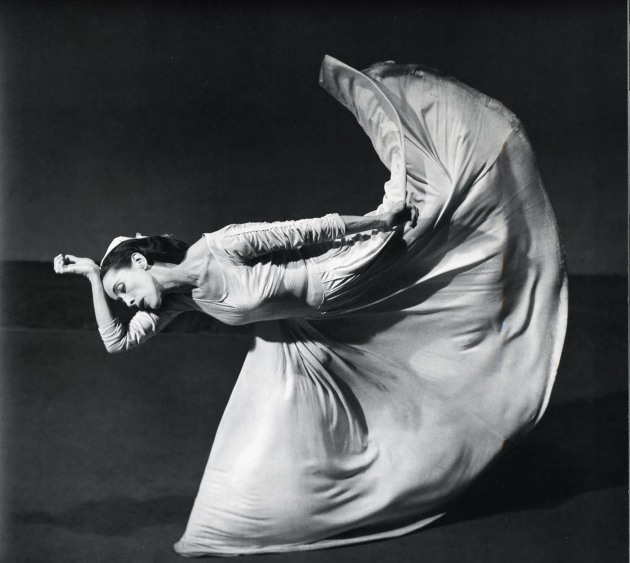
In 1941, Morgan and Graham published the photobook Martha Graham: Sixteen Dances in Photographic Sequence. It would become highly celebrated, and its images have since been exhibited internationally, including at MoMA, the National Gallery of Ireland, Paris Photo, and most recently at Australia’s own NGV in Women Photographers 1900–1975: A Legacy of Light, where Morgan’s work appeared in the section on body and movement. The photobook’s most iconic image is Letter to the World, Kick, 1940, from Graham’s choreography inspired by the poetry of Emily Dickinson. The image is striking for the control and intensity of Graham’s horizontal torso, contrasted with the lush flare of her skirt, as revealed in a gelatin silver print. It mediates repression and release through a mastery of chiaroscuro. The image’s dissemination was also aided by Andy Warhol’s production of several screenprints based on the kick in 1986.
Graham and Morgan would collaborate on numerous occasions over the course of sixty years, and Graham later remembered their work as one of the most fruitful ventures of her career. In 1980, she recollected, “It is rare that even an inspired photographer possesses the demonic eye which can capture the instant of dance and transform it into timeless gesture. In Barbara Morgan, I found that person.”
Dance has long had a significant impact on photography. The dancer is often a figure of play and experimentation, whose movements investigate and abstract form. One need only think of the peculiar, angular photographs of Moulin Rouge dancers by Léopold-Émile Reutlinger, or the dynamic figures in Hy Peskin’s Harlem Hep Cats, 1939. There are also times when dance takes on a conceptual form, as in Morgan’s 1938 montage Spring on Madison Square.
The dominant figure is Erick Hawkins, a shadow overlaying a New York park. Although he is not dancing, precisely, in this image, Hawkins was the first male dancer to join the Martha Graham Company. In the scene, the pedestrians move slowly through the winter mire, while Hawkins presses forward as an embodiment of spring. Dance becomes a key metaphorical emblem. Framed against the uniform rhythms and bodily repression of daily life, dance is portrayed by Morgan as a rebellion.
Dance photography requires the depiction of a continuous art through a static medium, and is exceedingly difficult for this reason. To capture the nature of a movement, as Morgan does in The Kick, is a skill. To epitomise a choreographed piece in its entirety in two or three images, as Morgan strove to do in the photobook, was formidable. First, Morgan would study Graham’s dance. Then, over several days, she would try to recall it until she could visualise only the piece’s most striking movements, those that represented the dance’s “concept”. Only then would she and Graham meet in the studio.
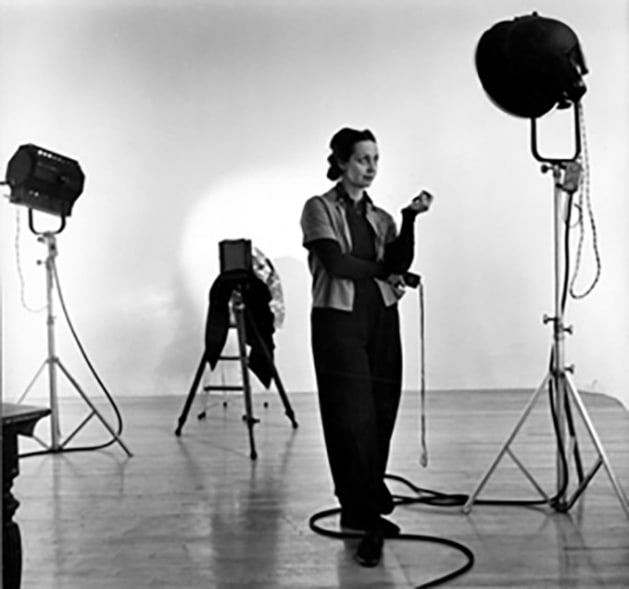
Morgan found that “to epitomise... a dance with camera, stage performances are inadequate, because in that situation one can only fortuitously record. For my interpretation it was necessary to redirect, relight, and photographically synthesize what I felt to be the core of the total dance.” As a photographer, Morgan was fastidious. “A terror,” Graham called her. Innumerable angles and shots were taken; skirt movements were repeated to achieve the right arc. Graham recollected lying on the studio floor, trying to catch her breath between shoots. The effort was necessary, for it was through Morgan’s technical perfectionism that the images were able to so precisely embody the dances’ essence.
Across Morgan’s broader body of work, it is evident that she was not simply interested in capturing individuals. Rather, she used figures to elucidate religious and social concepts. What drew her to Graham’s choreography was its ritualism. It reminded her of Native American “ceremonial dances which invigorate the tribe in drought and difficulty.” Amid the defeatism of the Depression, one can imagine how refreshing the modernism of Graham’s dance must have seemed, and how invigorating and hopeful. To Morgan, revealing the essence of the dances through photography was an intrinsically spiritual venture. It had to “go beyond theatre. Dance had to enter the spirit of the viewer from the spirit of the giver.”
Dance photography, as realised by Morgan and Graham, reveals its unique ability to distil movement, force and human expression into a single frame. Their partnership demonstrates that the meeting of two art forms can produce a vivid expression of spirit and form.
“Primarily, I am after that instant of combustion, when all the energies of the spirit are wonderfully coordinated with the action of the body. How to get that onto a negative!” Barbara Morgan
- Zoe Forbes